Showing posts with label Officially Ignored. Show all posts

Monday, August 13, 2012

Sexism in The Affordable Care Act

This is part discrimination and also part dumb. From a change.org petition:

On August 1, 2012 many more health care services became available to women without co-pays, deductibles, or out-of-pocket expenses. While this can be seen as a victory for women's health, there are many services that affect men in equal or similar ways that still require men to be able to afford those cost-sharing requirements.

WOMEN ARE PROVIDED WELL-CARE VISITS WITHOUT DEDUCTIBLES, CO-PAYS OR OUT-OF-POCKET COSTS IN ORDER TO OBTAIN RECOMMENDED PREVENTIVE SERVICES. MEN WILL BE DENIED THESE WELL-CARE VISITS UNLESS THEY CAN COME UP WITH THE REQUIRED EXTRA FUNDS.

BREAST CANCER SCREENINGS ARE FULLY COVERED WITHOUT DEDUCTIBLES, CO-PAYS OR OUT-OF-POCKET COSTS. PROSTATE CANCER SCREENINGS REQUIRE MEN TO FIND A WAY TO PAY THOSE EXTRA COSTS OR BE DENIED PREVENTIVE CARE.

ALL FDA APPROVED CONTRACEPTIVES AND STERILIZATION PROCEDURES ARE TO BE MADE AVAILABLE TO WOMEN WITH NO OUT-OF-POCKET COSTS, DEDUCTIBLES OR CO-PAYS. MEN WOULD BE REQUIRED TO PAY OUT-OF-POCKET COSTS, DEDUCTIBLES OR CO-PAYS.

COUNSELING- SEXUALLY TRANSMITTED INFECTIONS PREVENTION COUNSELING IS FULLY COVERED FOR ALL SEXUALLY ACTIVE WOMEN BUT ONLY FOR HIGH RISK MEN.

ALL SEXUALLY ACTIVE WOMEN CAN BE SCREENED FOR HIV WITHOUT OUT-OF-POCKET COSTS, DEDUCTIBLES, OR CO-PAYS BUT ONLY HIGH RISK MEN CAN BE SCREENED WITHOUT THOSE COSTS.

The above is really stupid as, well, women tend to have sex with man and there are far more men in the USA with HIV than women.

ALL WOMEN WILL BE SCREENED FOR DOMESTIC VIOLENCE WITHOUT DEDUCTIBLES, CO-PAYS OR OUT-OF-POCKET COSTS. DESPITE MEN BEING VICTIMS OF DOMESTIC VIOLENCE (DV) AT EQUAL RATES AS WOMEN, MEN ARE DENIED NO-COST SCREENINGS.

THERE ARE NO FEDERAL HEALTH OFFICES DEALING WITH MALE-SPECIFIC HEALTH ISSUES. NONE FORTHCOMING EITHER. NONE. THERE ARE MANY WOMEN'S HEALTH OFFICES AND AGENCIES AND MANY MORE TO BE FORMED IN THE AFFORDABLE CARE ACT.

Much of the usual, "we do not really care about men's health stuff".

Tuesday, June 12, 2012

Women in America or arguments for a council on men and boys

This is about the following report:

WOMEN IN AMERICA Indicators of Social and Economic Well-Being - March 2011 - Prepared by U. S. Department of Commerce, Economics and Statistics Administration
and Executive Office of the President Office of Management and Budget

This report is kind of big thing not only because of the sheer size but also:

In cooperation with Bureau of Justice Statistics, Bureau of Labor Statistics, Census Bureau, National Center for Education Statistics, National Center for Health Statistics, National Center for Science and Engineering Statistics for White House Council on Women and Girls

White House Council on Women and Girl. Like my title states this is going to be an argument that a council for men and boys is also needed. (I am not saying there are no issues facing girls and women, there are many)

So I read through that report and copied the headlines (and sometimes further explanations as the headline in this context here can sometimes be misleading) for points a council for men and boys might also be interested in. Here we go:

While the populations of both men and women are aging, women continue to outnumber men at older ages.

Most adults live in households headed by married couples; single mother households are more common than single-father households. [Father's rights / divorce]

Women’s gains in educational attainment have significantly outpaced those of men over the last 40 years.

Female students score higher than males on reading assessments and lower than males on mathematics assessments. [...] The percentage of both boys and girls proficient
in math has increased significantly since 1990, although girls are still slightly less likely than boys to be proficient in math.

Higher percentages of women than men age 25–34 have earned a college degree.

More women than men have received a graduate education.

Higher percentages of women than men participate in adult education.

Unemployment rates for women have risen less than for men in recent recessions.

The above are fairly obvious, the next is a bit tricky.

In families where both husband and wife are employed, employed wives spend more time in household activities than do employed husbands. [...] On an average workday in 2009, employed married women spent 1.6 hours in household activities and an additional hour caring for household members. In contrast, employed married men spent nearly one hour in household activities and about 40 minutes caring for household members. [...] Employed married men spent more time in labor market work and related activities (including commuting) on an average workday in 2009 than did employed married women 8.8 hours and 7.6 hours, respectively.

Some math:
Employed wives: 1.6 + 1 + 7.6 = 10.2
Employed husbands: 1 + 0.67 + 8.8 = 10.47

It is the usual stuff, the headline makes it look like husbands do less than wives yet when you add up the numbers, there is almost equality. They also add the men have more leisure time statistic, but when you look at the graph, as women sleep more and do more other activities it seems to even out.

Women have longer life expectancy than men, but the gap is decreasing. [as if that is a bad thing]

More women than men report having a chronic medical condition. [...] Women report a higher prevalence of asthma, chronic bronchitis and emphysema, cancer, and arthritis. Men report a higher prevalence of heart disease and diabetes.

Females age 12 and older are more likely than males to report experiencing depression. [...] At all ages, females experience higher rates of depression than males. In any two-week period, 8 percent of women and girls report experiencing clinically significant depression, compared to 5 percent for men and boys. [Gap is not that big and I assume depression is underreported in men]

More than one-third of all women age 20 and older are obese. The proportions of women and men age 20 and older who are obese are similar.

The share of women age 18–64 without health insurance has increased. [...] Less than half of all women meet the Federal physical activity guidelines for aerobic activity. [...] Overall, 43 percent of women age 25 and older met the Federal aerobic physical activity guidelines in 2009, compared to 51 percent of
men. [Gap is not that big]

Many women do not receive specific recommended preventive care. [...] Only 53 percent of women age 50 and older have ever received a sigmoidoscopy or colonoscopy. Men are somewhat more likely to report ever having these treatments (56 percent) than women in this age group. [...] Women age 50 and older are somewhat more
likely than men to have obtained an influenza immunization in the last year (53 percent compared to 49 percent) but the shares of women and men age 65 and older having ever received a pneumococcal immunization were similar. [...] Women age 18 and older are more likely to have had their blood cholesterol checked in the last 5 years than men (78 percent and 73 percent, respectively).

The share of women age 18–64 without health insurance has increased. [...] In 2009, 18 percent of nonelderly women (age 18–64) lacked health insurance, compared to 13 percent in 1984. For men, the percentage of uninsured rose from 16 percent to 24 percent.

One out of seven women age 18–64 has no usual source of health care. [...] Approximately 15 percent of women and 26 percent of men age 18–64 have no usual
source of health care.

Nonfatal violent crimes against women declined between 1993 and 2008. [...] The nonfatal violent victimization rate for women fell from 43 per 1,000 women in 1993
to 18 per 1,000 in 2008. During the same period, the rate of nonfatal violent victimization of men declined from 64 to 22 per 1,000 men.

Homicides of females declined between 1993 and 2008. [...] In 2008, 3,541 females and 12,731 males were victims of homicide.

The imprisonment rate for females has increased significantly. [...] The imprisonment rate for females quadrupled between 1985 and 2008, from 0.17 per 1,000
females to 0.68 per 1,000 females. The 2008 rate was much greater for males (9.52 per 1,000 men) than for females.

There are a whole lot of issues men and boys face. It is time to take a closer look at them.

Saturday, June 2, 2012

OECD Better life index

Something fascinating happened:

The Organisation for Economic Co-operation and Development's online Better Life Index measures well-being based on factors including health, jobs, community, education, safety and 'work-life balance'.

Researchers have now, for the first time, broken down the results into age and gender as well as by country.[...]

The OECD researchers said: 'Much has been said and written about the need for greater gender equality, but it is a rather complex picture.

'True, men earn more and work more than women, but they are also more likely to be victims of assault or murder, while women live longer and have stronger social networks but are more likely to end their lives in poverty.'

Before I link to the report itself, here is what I find remarkable. I have seen such indexes that compare the sexes from time to time. Usually when it comes to a rating of equality, when women do better than men this is interpreted as having equality. As an example, take the global gender gap report:

The Report’s Gender Gap Index ranks economies according to their gender gaps and their scores can be interpreted as the percentage of the inequality between women and men that has been closed. Information about gender imbalances to the advantage of women is explicitly prevented from affecting the score.

A somewhat crass example is Russia here. In the global gender gap report the life expectancy of Russian men is about a decade lower than for Russian women. This is interpreted as having equality.

Now what the OECD is doing seem to take gender into account a bit fairer, and I say a bit here as I am sure one can use many variables to point someone into a certain direction. This one looks good from a masculist standpoint.

In 25 countries, judging by that index, women have a better life, in 2 countries (Belgium and France) it is about equal and in the remaining 9 countries (Chile, Germany, Hungary, Italy Luxembourg, Portugal, Slovenia, Spain and Turkey) men are ahead.

Taking a closer look at the USA:

How to read the following table: Negative values mean inequality against men, while positive values represent inequalities against women. 0 means Equality. This is a bit different than the article that uses 1.0 as equality and does not give out negative values. I changed that so I could calculate a total number. Also keep in mind that for minor differences (see voter turnout) the report gives us a graph of who is in favour, yet does not give out a number other than 1.0 (=equality). So yes, women have a higher voter turnout, however the number is not that significant.

Gender Equality Ratings - USA


Section 1 - Jobs
----------------------------------------
Job Security                          0
Personal Earnings                   0.3
Employment Rate                     0.1
Long Term Unemployment Rate        -0.3
----------------------------------------
                                    0.1

Section 2 - Community
----------------------------------------
Quality of Support Network            0
----------------------------------------
                                      0

Section 3 - Education
----------------------------------------
Years in Education                 -0.1
Student Skills                        0
Educational Attainment                0
----------------------------------------
                                   -0.1

Section 4 - Environment
----------------------------------------
Water Quality                      -0.1
----------------------------------------
                                   -0.1

Section 5 - Civic Engagement
----------------------------------------
Voter Turnout                         0
----------------------------------------
                                      0


Section 6 - Health
----------------------------------------
Self Reported Health                  0
Life Expectancy                    -0.1
----------------------------------------
                                   -0.1


Section 7 - Life Satisfaction
----------------------------------------
Life Satisfaction                  -0.1
----------------------------------------
                                   -0.1


Section 8 - Safety
----------------------------------------
Homicide Rate                      -2.5
Assault Rate                       -0.3
----------------------------------------
                                   -2.8


Section 9 - Work-life Balance
----------------------------------------
Leisure/Personal Time                 0
Employers Working very long hours  -1.4
----------------------------------------
                                   -1.4

Sum
----------------------------------------
                                   -4.5

The not so surprising findings. When it comes to jobs in terms of employment and earnings men do better. As for civic engagement as well as in the community it is about equal. In terms of education, health, life satisfaction, safety and work-life balance men do worse than women. Men also self-report less satisfaction with the water quality, whatever that is supposed to show us.

All in all, this is a nice overview of recent problems men face.

Wednesday, April 18, 2012

The GMP on the affordable care act

How the times have changed. I remember being fed up with the GMP but more recently it seems there has been a paradigm shift and with Noah Brand (from NSWTM) as new editor in chief the site is certainly much better than before. So, there have been 2 interesting posts on the ACA recently:

For the first time ever, the U.S. government will expand access to preventive health services for women without requiring equivalent coverage for men. The U.S. Affordable Care Act (ACA), sometimes labeled by critics as “Obamacare,” will be rolled out using rules likely to deny men equal access to contraception, sterilization, sexually transmitted infection prevention, domestic violence screening and counseling, and even counseling for HIV-positive men.

[...]In a nutshell, women’s IUDs, contraceptive pills and implants, tubal ligations and birth control counseling must be provided without co-pays, doctor’s visit charges, or deductibles, while insurance companies will be free to charge men for vasectomies and contraceptive counseling. Women will universally receive free counseling if they test HIV-positive, but HIV-positive men will not. HPV can result in anal cancer and genital warts in men as well as cervical cancer in women, but no-cost HPV DNA testing will be added to free pap smears for women, while men pay for HPV tests or go without. The Centers for Disease Control found that 28.5 percent of men—over 40 million men—experience rape, physical violence, or stalking by an intimate partner. Those men, unlike women, will first have to ask for help and then pay out of pocket to receive it.

In contrast, a mental health service that men disproportionately need, is not a preventive health service under this Act or HHS guidelines. Men commit suicide at a rate nearly four times that of women. Young men are at particular risk: the National Institute of Mental Health reports that the suicide rate for young men during late adolescence is almost five times that of their female peers, and by their early twenties the rate rises to almost six to one. Reminiscent of Anatole France’s remark about the majestic equality of the law, suicide prevention services are excluded from the ACA / HHS no-cost-sharing package for both women and men.

[2nd Article starts here...] In effect, the sex-neutral insurance pricing required by the ACA already shifts some of the cost of future medical services consumed by women to men. The 2012 report cited above estimated the additional premium costs now borne by women to be over $1 billion a year. Thus, under the ACA, men can expect to bear at least half of those costs—half a billion dollars a year—for services consumed by women.

The theory behind these two fundamental health insurance payment changes wrought by the ACA, is that we are all in it together when it comes to healthcare. Until, in the case of men’s access to reproductive health services and preventive care for men’s diseases, we aren’t. [...]

Erin Gloria Ryan put it well in her recent Jezebel post: “When a woman consents to sex, she is not also consenting to pregnancy.” A woman in the U.S. has a constitutional right to terminate hosting a fetus and unilaterally end any obligation to support and raise a child. A precisely opposite legal regime applies to men. When a man has heterosexual sex he is presumed to have consented to paternity and a couple of decades of child support. To control their own fertility, straight men, unlike women, are entirely dependent on complete abstinence or the highly competent use of very limited and often ineffective birth control methods.[...]

The Federal decision to mandate no-cost preventive reproductive healthcare only for women must be viewed against the backdrop of 1) the sex discrimination prohibition in the ACA; 2) gender-neutral insurance pricing and the individual mandate under the ACA; 3) widespread lack of reproductive health and suicide prevention services for men; 4) the five-year life expectancy gap that disfavors U.S. men; and 5) the 50-year drought of public or private research funding for truly effective, reversible birth control for men. Any given man is some woman’s son or grandson, just as any given woman is some man’s daughter or granddaughter. Are we in this together, or aren’t we?

It is fantastic that women have reproductive rights and many contraceptive choices. No-cost preventive care addressing women’s unique health concerns is necessary. That is not the issue. The issue is that this administration and leading health organizations that purport to believe in widespread access to health care do not seem to hold men in equal regard to women when it comes to birth control, STI services, HIV counseling and screening and counseling for intimate partner violence.

When contacted by GMP, for example, Planned Parenthood was unable to cite anything it had done—or would do—with its impressive lobbying and public affairs operation to encourage HHS to provide men with equal access to reproductive health care under the ACA. [...]

The Guttmacher Institute’s last major review of men’s reproductive health needs and barriers to meeting those needs found the following barriers to addressing the reproductive health of men in their own right: Absence of political will to turn advocacy into action; Lack of funding; Logistical challenges of incorporating men’s services into existing programs; and Inadequate staff.

Men are carefully trained from infancy not to show pain, not to complain about hard knocks and not to seek help. Men are also inaccurately assumed to be omniscient about matters of sex and sexual health. Under these circumstances shouldn’t it be the duty of HHS officials, Members of Congress, public health school deans, medical school professors, public health advocates, the philanthropists and boards who direct major foundations, and maybe even a U.S. President, to demonstrate leadership on this issue?

Friday, March 2, 2012

The invisibility of the default....

I came across this in one of yesterdays posts and believe TyphonBlue of Genderratic has posted something in a similar vain:

The problematics of gender stereotypes are not only ripe within organizational policies (Kirby, 2000; Kirby & Krone, 2002); they also are present in the everyday politics and unwritten rules of organizational culture practices (Kirby, 2006/2003; Kirby & Krone, 2002; Levine & Pittinsky, 1997; Medved, 2004). “Work family balance” is a gendered issue (read: a woman’s issue) as many issues that women and men might both be concerned about become gendered by the very presence of women’s interests. Feminists have long held that gender issues are often interpreted as being only about women, because patriarchal interpretations suggest gender is an essentializing category where, put simply, gender equals women. Men are apparently not gendered; they are the norm. Women are “the other,” the second sex, and can only be compared to the masculine normative standard (de Beauvoir, 1952). As Ashcraft and Mumby (2004) assert, women are “visibly gendered ‘others,’ while men are erased as the genderless norm” (p. xiv). Thus, by interpreting the meanings of gender, the essentializing perspective then highlights the categories of “femininity” and “woman” as communicating gender rather than those of “masculinity” and “man.” - - STAY-AT-HOME FATHERS: MASCULINITY, FAMILY, WORK, AND GENDER STEREOTYPES - David John Petroski, Paige P. Edley - 2006

Good for the arguments that actually everything besides women's studies is men's studies.

Tuesday, June 28, 2011

Officially ignored

While reading the entry on gender equality on Wiki I was a tad annoyed to find links in it that are via definition not about gender equality (feminism maybe, but not gender equality).

Kind of annoying. Apparently it is assumed that gender equality means caring about women but forgetting men.

For instance we have the Global Gender Gap Report (didn't I blog about this before?)

The Report’s Gender Gap Index ranks economies according to their gender gaps and their scores can be interpreted as the percentage of the inequality between women and men that has been closed. Information about gender imbalances to the advantage of women is explicitly prevented from affecting the score.


Or the Gender Parity Index:

UNESCO describes attempts to eliminate gender disparities in primary and secondary education and emphasizes the plight of girls in unequal access in third world countries. However, the GPI ignores the gender disparity that benefits first-world women in tertiary education as in Iceland, for example, where 65% of students enrolling in tertiary education are female.


And of course the Gender-related Development Index:

The UN uses a different standard for male and female life expectancy, basically assuming that it is natural that women should live about 5 years longer than men.


That is so egalitarian....anyhow linked via the last one, I came across this:

A "fair innings" between the sexes: are men being treated inequitably?

In most modern developed communities, women are known to live longer than men. A less known fact is that in many statistics reporting differences in life expectancy between socio-economic classes, on average women in the worst-off social class live as long as men in the best-off social class, if not longer. It is true that women tend to have higher morbidity, or lower health-related quality of life, especially at advanced age, but this female disadvantage does not offset the life expectancy advantage sufficiently to lead to the conclusion that men and women enjoy comparable lifetime health prospects in these communities. Although there is much public and policy discussion about the inequity of health inequalities between the social classes, there is relatively little discussion about such inequalities between the sexes. The paper first discusses the applicability of the fair innings argument to the issue of inequality in health between the sexes. It critically examines six arguments concerning why inequality in health between the sexes may or may not be an inequity. Next, special attention is given to the argument that it is wrong to judge the fairness or unfairness of health inequalities in isolation, but that this judgement should be made only after considering other inequalities relevant to overall human well-being, many of which are believed to work to the disadvantage of women. An analytical framework based on the Gender-related Development Index (a supplementary index to the Human Development Index) is taken as a starting point, to address the issue of health and overall well-being. But this is found wanting, and suggestions are made as to how its conceptual and empirical properties could be improved. Meanwhile we conclude that a prima facie case has been made that the current distribution of health in most countries does not give men a "fair innings", but the broader question about general well-being remains unresolved.


Hear, hear. And as I was not able to get the complete article as a source, there are some citations which can be taken from other articles.

The implication [...] is that men do not get a “fair innings” in a publicly financed health care system in which they subsidize women’s health care use [Tsuchiya and Williams (2004)].


The importance of men’s health is not simply a utilitarian matter of the greater good in relation to the economic health of the country. If health inequalities between social and occupational classes or ethnic groups are considered to be a major issue of equity—or intrinsic fairness—then the poorer health status of men poses a similar challenge. It is difficult to diminish the importance of men’s health on the basis of either riskier/unhealthy behaviours, or as a function of occupational roles, when such issues are seen as being important factors to be addressed when confronting other forms of health inequality.

[...]The international literature has identified that men tend to have higher mortality rates, but that women tend to have higher morbidity rates, especially at advanced age. However the reduced quantity of life on the part of men does not appear to be offset by the reduced quality of life on the part of women. Rather, the emerging international literature on quality-adjusted life expectancy and disability adjusted life expectancy in developed countries indicates a persisting inequality of poorer lifetime health outcomes among men compared to women in the same community.


A summary by the same author:

Equitable development towards the abolition of gender will most likely involve two moves. The first is the one where women move into spheres that have traditionally been regarded as male, and as a result, expose themselves to higher levels of health risks. The second is one where men move into spheres that have traditionally been regarded as female. If men are to benefit from the lower health risks traditionally enjoyed by women, they will also have to reduce their labour market activities at the same time. In this respect, a re-assessment of what constitutes “masculinity” would be good for men’s health, and, to the extent that this is in line with what women want, it will be good for women’s well-being as well, if not their health.

[...]For men, the issue is relatively straightforward: they get to engage more with their children, they get to work less, they bear less responsibility for generating cash income, and as a result they get better health. The fact that more men do not currently make choices along these lines (“because the man should put the bread on the table”) is indirect proof that the genderless society is yet to come. On the other hand, for women, the picture is more complicated: they see less of their children, they get to work harder, they bear more responsibility for financing the family, and as a result their health will be worse. So, why would women want to do it? What does “development” mean to women in this context? It is crucial to note that it has been predominantly women, not men, who have struggled for changes in the traditional gender system. Women have wanted to escape an exclusive occupancy in the domestic sphere because it is lonely, repetitive and boring, involving hard work, associated with low nor no social status, under-rewarded and un-paid, etc., whereas men have not valued the prospect of entering closer relationships with their children for the very same reasons. With more
information regarding the health consequences for men, there may be some increased interest amongst men towards gender abolition. However, unless the current conceptualisation of masculinity changes, this is unlikely to lead to a major movement, since the very essence of conventional masculinity is that “real” men should not be affected by concerns over their own health and safety. Furthermore, the public sphere of resources, independence, and politics has
traditionally been valued more highly than the domestic, private sphere of caring. The asymmetric power dimension of the gender system, which links the male with the public (and therefore to superiority) and the female with the private (and therefore to subordination), is highly
relevant in this context.

In gendered societies, women and men have been subjected to different behavioural and aspirational norms, which seem to have long term health effects. We have pointed out that equitable development towards a genderless society will probably have a negative impact on women’s ELQ relative to men’s. An interesting question is, if health and longevity are key elements of well-being, then what does it mean, when improving well-being beyond a certain
point by removing an asymmetric and inequitable social system seems to result in their reduction? It is possible that certain forms of the patriarch gender system have in effect allowed women to exploit men so that they do not have to shoulder the fair share of the health risks
associated with human/social life. The breaking up of the gender system will mean women giving up the undue advantages regarding life time health they have so far enjoyed.

[...]Insofar as the current gender system works to the advantage of female ELQ, equitable development towards abolishing this will imply women having to give up the excess health advantage, just like men having to give up their excess socio-economic advantages. Assuming full information and rational choice, if a significant proportion of women do make choices that imply reducing their own ELQ, it will mean these women do not regard mere ELQ as an absolute
good: they will be better off with less health and more choices/control. Sen (2002) argues “health is among the most important conditions of human life and a critically significant constituent of human capabilities” (p660 l). We agree, but we will also like to point out that health alone is no
good if there are no socio-economic opportunities to pursue. Health and longevity are not absolute, but is something that can be traded off with other opportunities in life.

Wednesday, October 28, 2009

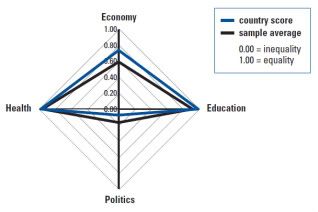
The Global Gender Gap Report 2009 - A misleading name

The new "Global Gender Gap Report" is out. In this report, gender equality is rated by:
Economic participation and opportunity
Educational attainment
Political empowerment
Health and survival
My biggest problem with this report is the misleading name as this reports does tell us more about womens' position in society than about gender equality. I cite:
Gender equality vs. women’s empowerment

The third distinguishing feature of the Global Gender Gap Index is that it ranks countries according to their proximity to gender equality rather than to women’s empowerment. Our aim is to focus on whether the gap between women and men in the chosen variables has declined, rather than whether women are “winning” the “battle of the sexes”. Hence, the Index rewards countries that reach the point where outcomes for women equal those for men, but it neither rewards nor penalizes cases in which women are outperforming men in particular variables.
If you ever spend some time thinking about gender equality in western countries you will certainly be able to pretend the outcome. Men will lead in the economic and political category, while women will lead in the educational and health/survival categories. This report has an interesting way to define gender equality.

Let us take Russia as an example. Wikipedia tells me the life expectancy for Russian men is almost 14 years lower than for Russian women (data from 2009). Life expectancy is besides sex ratio at birth the only criteria for the "Health and Survival" category.

When it comes to education, the report looks at the following criterias:
Female literacy rate over male value
Female net primary level enrolment over male value
Female net secondary level enrolment over male value
Female gross tertiary level enrolment over male value
And what can I say, Russian women are doing very well here, too. For the first 3 itmes the ratio is equal, for the last one the female-to-male ratio is 1.35 (for 100 men on Russian universities there are 135 women).

Now the above results for women, as rated by the report, would lead to a horrible rating in the category, but as we are talking about men here


we apparently have gender equality. If it isn´t cynical to call a difference in life expectancy of almost 14 years gender equality, I don´t know what is. And cynical might be the wrong word here.