Wednesday, March 11, 2009

Women should be hit for wearing sexy clothing in public, one in seven believe

Another awful article that uses sleight of hand and rhetorics to turn data, that isn´t even that bad, into a call for action. But let us start dissect the article:

We start with the headline, which is probably one of the "facts" people will keep in mind:
Women should be hit for wearing sexy clothing in public, one in seven believe
This is the shocker. Reading the study we find out that that is actually a lie. The Times article corrects itself in the first sentence.
One in seven people believe it is acceptable in some circumstances for a man to hit his wife or girlfriend if she is dressed in “sexy or revealing clothes in public”
Which is far closer to the truth. But let me continue before I focus on the actual data, because there is another lie presented in a similar way than the headline:
A similar number believed that it was all right for a man to slap his wife or girlfriend if she is “nagging or constantly moaning at him”.
Which is again wrong as the headline. What does the data say:

Acceptable is something only a very small minority agree with in (1-6%). The 14% (or 1 in 7) said "it is acceptable in some circumstances but not in other". Which is a big difference to saying it is (always) acceptable. The overwhelming majority (79-90%) agreed that it is not acceptable to hit women at all in those cases. But let us illustrate the data in another way. Imagine you are asking 10 people, 5 men and 5 women. Eight will answer it is never acceptable and 1 man and 1 woman will say, "Well I can think of some circumstances where it would be okay to hit a woman". The minority that says it is acceptable doesn´t even fit in my definition. Shocking data?

We continue with the lies:
The findings of the poll, conducted for the Home Office [...] 1,065 people over 18 questioned last month [...]
I guess this tidbits should help convice us that we are talking about rock solid data. Reading the study that the article linked as well makes us wonder if the author read that piece:
- Please note that this research is not part of the Home Office National Statistics programme but is exploratory work. Results should be seen as indicative and directional rather than absoulte. It is not recommended that exact percentages are used outside the context of this document
- Telephon survey in Wales and England asking 915 people age 18+
- Please note that statisitcal reliability tests work on the basis of a pure random sample. This survey uses quotas to obtain a sample that is closely represantative to the population so our survey does not use a completely random sample. Statistical differences should be used only as a guide.
Adjusting the numbers a bit (I guess 1.000 is a magic line that makes surveys more reliable), fantasizing a connection to the Home Office Statistics programme and worst of all presenting us numbers as absolutes that should be seen as directional in a survey that does not even use a completely random sample. And do we see a direction? Yes, an overwhelming majority say violence against women is never acceptable with some men and women saying, well maybe in such a case.

So what follows is a call for action, there should be something done about the violence some people may find acceptable:

Jacqui Smith, the Home Secretary, said: “Violence against women and girls is unacceptable in any form no matter what the circumstances are.”

Ms Smith said that more needed to be done to challenge attitudes that condoned violence against women and girls.

She was speaking as she launched a police lead review of whether new laws are needed to tackle serial domestic violence abuses and whether there is a link between the early sexualisation of young girls and violent abuse.

One idea being considered is to allow women to ask police if a new partner has a record of domestic violence. A pilot scheme that allows women to request information on whether a new partner has a history of child sex abuse is currently underway in four police force areas of England and Wales.

But Ms Smith was confronted at a working breakfast at which she launched the campaign by a veteran domestic violence campaigner.

Sandra Horley, chief executive of Refuge, accused Ms Smith over breakfast at the Cinnamon Club in Westminster of using “gimmicks” and “spin”.

She said that government action so far had been “piecemeal” and condemned plans for a database of serial domestic abusers.

Ms Horley said: “We have had enough talking – we need action. As for the perpetrators’ register, it is a gimmick and doesn’t address the root problem.

“The majority of violent men don’t come to the attention of police and it won’t keep women safe.

“Police can’t be expected to monitor relationships and love lives of offenders.”

She went on: ”The Government is hoping to get away with useless initiatives like this register and it is hypocritical to sound tough and do little.”

She said that the cases of Sabina Akhtar and Katie Summers showed that not enough was being done.

Ms Smith tried to interrupt the tirade but was shouted down before Vera Baird, the solicitor general, stepped in to argue the Government’s case.

Well it seems both don´t seem to agree what should been done, but agree that something has to been done.

As someone who is against all kinds of violence, not just violence against women, let us see what another poll tells us about the acceptance of violence against men:


Survey finds male abuse approval

Morethan half of women questioned at a Glasgow university said they approved of wives hitting their husbands.

The Glasgow Caledonian students were among 6,500 women surveyed from 36 universities for an international study into attitudes on domestic violence.
Of the 200 women, 60% said it was acceptable for women to hit their husbands while 35% admitted assaulting their partner.

A total of 8% admitted injuring them - the highest rate in the study.
The injured men suffered bruises, cuts or broken bones.

Among European students, only English women were more likely to have carried out assaults, with 41% admitting that they had punched or kicked their partners.
However, those inflicting injury was less than in Scotland, at 5%.

Just under a quarter of those in Scotland admitted there were occasions when it would be acceptable for a husband to slap his wife.

Worldwide, more than 4,800 female students approved of assaulting their partner and 2,000 admitted to pushing, shoving, slapping, throwing objects and twisting their partner's arms or hair.

The findings, printed in the Sunday Times, will be published next month in the European Journal of Criminology.

'Bottom line'
Professor Murray Straus, co-author of the study, told the paper there was a need for better rehabilitation programmes for women with violent tendencies.

"This study raises questions about why there's so much violence between partners whether they're married, cohabiting or dating," he said.
"The bottom line is that we need make the same 'big deal' about violence by women as we do about men who behave violently."

In recent years, the Scottish Executive has spent hundreds of thousands of pounds on raising awareness of domestic abuse, including a helpline for victims which received more than 20,000 calls in 2005 -- an increase of 38% on the previous year.
David Smith, honorary professor of criminology at Edinburgh university and editor of the European Journal of Criminology, said he found the results "surprising".
"The number of women who admit to assaulting men is interesting as it's well known that men are more violent than woman." - from here
Nothing more to say.

Friday, March 6, 2009

Yep, that is the reason....

I came across that bit on a feminist site (I am not going to name) and that just speaks for itself:
I've never considered running for office. That might seem kind of normal, except I was a political science major in college and follow electoral politics very carefully. I'm a feminist who cares deeply about the lack of female representation in politics.
And reminds me of a joke I heard before:
For 10 long years, every night Susan was praying to win the lottery. One night after a prayer the room is suddenly embedded in light and angelic choirs can be heard. Then a deep voice says: "Give me a chance Susan and buy a damn lot!"
Oh, the irony...

Monday, March 2, 2009

Abortion in Numbers

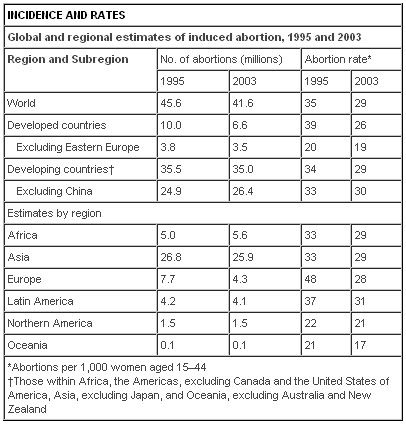
I came across some statistics and really was shocked. I didn´t knew that abortions (especially in the US) were so common. Here are the facts:

Each year, women have an estimated 46 million abortions worldwide. Of these, 20 million are clandestine abortions and are generally unsafe. More than three-quarters of all abortions occur in developing countries. (The Alan Guttmacher Institute (AGI), Sharing Responsibility: Women, Society and Abortion Worldwide, New York: AGI, 1999, Chart 1.1.)

In 2003, 1.29 million abortions were performed in the United States. From 1973 through 2003, more than 43 million legal abortions occurred in the United States. (Finer LB and Henshaw SK, Estimates of U.S. Abortion Incidence in 2001–2003, 2006, , accessed Nov. 29, 2006.)

The abortion ratio is the proportion of pregnancies (excluding miscarriages) ending in abortion. In 2003, the abortion ratio was 24%, meaning that about one-quarter of all U.S. pregnancies ended in abortion. (Finer LB and Henshaw SK, Estimates of U.S. Abortion Incidence in 2001–2003, 2006, , accessed Nov. 29, 2006.)

On the basis of current abortion rates, one in three American women will have had an abortion by age 45. (AGI, State facts about abortion, 2003, , accessed December 6, 2006.)
- from here

Nearly half of all pregnancies to American women are unintended; four in 10 of these end in abortion.

About half of American women have experienced an unintended pregnancy
- from here


Although abortion rates and ratios (the number of abortions for every 100 births) in Eastern Europe have fallen significantly in recent years, they remain higher than in any other region. In 2003, there were more abortions than births in that region (105 abortions for every 100 births).(Sedgh G, Henshaw S, Singh S, Åhman E, Shah IH. Induced abortion: rates and trends worldwide. Lancet 2007; 370: 1338–45.)

The lowest abortion rate in the world is in Western Europe (12 per 1,000 women aged 15–44). The rate is 17 in Northern Europe and 21 in Northern America (Canada and the United States of America).(Sedgh G, Henshaw S, Singh S, Åhman E, Shah IH. Induced abortion: rates and trends worldwide. Lancet 2007; 370: 1338–45.)

More than one-third of the approximately 205 million pregnancies that occur worldwide annually are unintended, and about 22% of all pregnancies end in induced abortion. (Sedgh G, Henshaw S, Singh S, Åhman E, Shah IH. Induced abortion: rates and trends worldwide. Lancet 2007; 370: 1338–45., The Alan Guttmacher Institute (AGI), Sharing Responsibility: Women, Society and Abortion Worldwide, New York: AGI, 1999., Population Division, United Nations Department of Economic and Social Affairs, World population prospects: the 2004 revision, New York: United Nations, 2005., Leridon H, Human Fertility: The Basic Components, Chicago: University of Chicago Press, 1977.)

Of the 23 million pregnancies that occur in developed countries, more than 40% are unintended, and 28% end in induced abortion. (Sedgh G, Henshaw S, Singh S, Åhman E, Shah IH. Induced abortion: rates and trends worldwide. Lancet 2007; 370: 1338–45., The Alan Guttmacher Institute (AGI), Sharing Responsibility: Women, Society and Abortion Worldwide, New York: AGI, 1999., Population Division, United Nations Department of Economic and Social Affairs, World population prospects: the 2004 revision, New York: United Nations, 2005., Leridon H, Human Fertility: The Basic Components, Chicago: University of Chicago Press, 1977.)

Of the 182 million pregnancies that occur in developing countries, more than one-third are unintended, and 19% end in induced abortion (8% are safe procedures and 11% are unsafe).(Sedgh G, Henshaw S, Singh S, Åhman E, Shah IH. Induced abortion: rates and trends worldwide. Lancet 2007; 370: 1338–45., The Alan Guttmacher Institute (AGI), Sharing Responsibility: Women, Society and Abortion Worldwide, New York: AGI, 1999., Population Division, United Nations Department of Economic and Social Affairs, World population prospects: the 2004 revision, New York: United Nations, 2005., Leridon H, Human Fertility: The Basic Components, Chicago: University of Chicago Press, 1977.)
- from here

"Highlights" for me were the incredible 1 in 3 women that abort in the USA once in their lifetime, the 40% unintended pregnancies in the developed world and the incredible rate in Eastern Europe (105 abortions - 100 births).

Thursday, February 26, 2009

Bad women: Trafficking

This is the first post with the label "Bad Women". This is not about demonizing women, but to counter the common stereotypte that women are good, while men are bad. This stereotype is often the reason that when you read news articles about female genital mutilation it is often not mentioned that this is a crime done to women by women and of course men that get "circumcised" under the same conditions than women achieve no attention, but I am extravagating now. When we talk about trafficking the exact same things happen.

I recently posted an article on AM I am dublicating right now:

A new report by the UNO about human trafficking. And well surprise, surprise among the criminals we find a huge amount of women:

UNODC Report on Human Trafficking Exposes Modern Form of Slavery

A Global Report on Trafficking in Persons launched today by the United Nations Office on Drugs and Crime (UNODC) provides new information on a crime that shames us all.

Based on data gathered from 155 countries, it offers the first global assessment of the scope of human trafficking and what is being done to fight it. It includes: an overview of trafficking patterns; legal steps taken in response; and country-specific information on reported cases of trafficking in persons, victims, and prosecutions.

At the launch of the Report in New York, the Executive Director of UNODC, Antonio Maria Costa said that "many governments are still in denial. There is even neglect when it comes to either reporting on, or prosecuting cases of human trafficking". He pointed to the fact that while the number of convictions for human trafficking is increasing, two out of every five countries covered by the UNODC Report had not recorded a single conviction.

According to the Report, the most common form of human trafficking (79%) is sexual exploitation. The victims of sexual exploitation are predominantly women and girls. Surprisingly, in 30% of the countries which provided information on the gender of traffickers, women make up the largest proportion of traffickers. In some parts of the world, women trafficking women is the norm.

The second most common form of human trafficking is forced labour (18%), although this may be a misrepresentation because forced labour is less frequently detected and reported than trafficking for sexual exploitation.
Global Report on Trafficking in Persons

The Report is here


Now we see a huge chunk of the perpetrators seem to be women (leading criminals in 30% of the countries). People could come to the conclusion that 70% of the criminals are indeed men. I suspected sth differen, quoting me again:

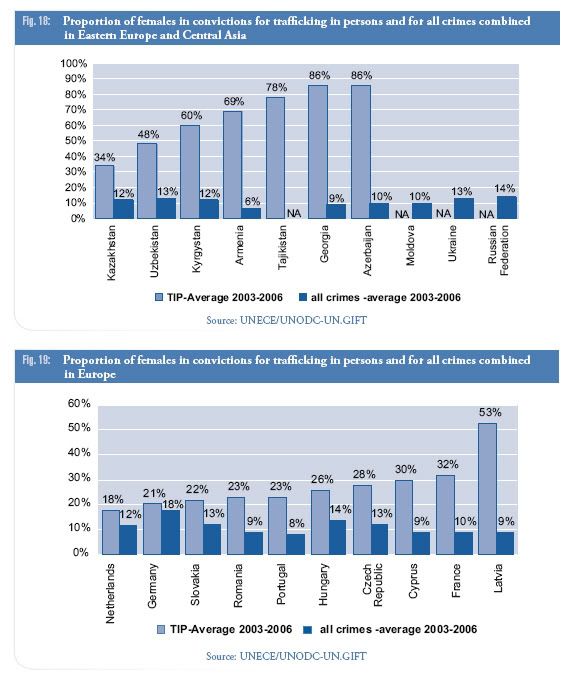
For example, do you believe there is more human trafficking in Germany (21% women) or in Georgia (86% women)?

I suspect if you count the numbers of all people Trafficking and do a gendered statistic there will be more than 30% women.
Very smart Feck....Now there is proof for that:

Most traffickers are women - UN 25/02/2009 14:20 - (SA)

Pretoria - Up to 75% of all perpetrators of human trafficking are women, according to a study released in Pretoria on Wednesday.

Apart from being offenders themselves, over 70% of women were victims of trafficking, noted the Global Report on Trafficking in Persons, by the UN Office of Drugs and Crime (UNODC).

The study was conducted in 155 countries, between 2007 and 2008.

"Between 65% and 75% of offenders are women," said UNODC regional representative Jonathan Lucas.

More women convicted for trafficking

In countries that participated in the study, 30% more women than men were convicted for trafficking.

"Women play an important role, more than men and boys," said Lucas.

[...]

Main form of exploitation

Sexual exploitation was found to be the main form of exploitation in southern Africa and the rest of the world. This was closely followed by forced labour, said Kruger. - from here

Isn´t this incredible? Women trafficking women. There is more on this topic and let me recite the bits I already posted:

The second most common form of human trafficking is forced labour (18%), although this may be a misrepresentation because forced labour is less frequently detected and reported than trafficking for sexual exploitation

Sexual exploitation was found to be the main form of exploitation in southern Africa and the rest of the world. This was closely followed by forced labour
This is another point that often is forgotten when we talk about trafficking. Male victims are often overseen although a lot of men are forced to work as slaves or to be child soldiers.

The fight against human trafficking has for more than a decade tried to protect women and children, often forgetting that men, too, are victims of "new slavery".

Thailand remains one of the region's busiest human-trafficking centres.

The National Human Rights Commission has looked into the stories of some of these forgotten victims - male migrant workers not recognised as casualties of the trade.

The commission reports that between July 17 and July 19 of 2003, six fishing trawlers with about 100 crew sailed from Tha Chalom in Samut Sakhon province to fish Indonesian territorial waters. Most of the crew were migrant workers and four were younger than 16. None were allowed home leave for three years. The trawlers returned to Thailand in July last year.

Thirty-eight never returned, dying on the job. Two were buried on one of Indonesia's myriad islands and the rest unceremoniously dumped at sea. One more crewmember died shortly upon his return.

Others returned home seriously ill - emaciated, emotionally disturbed and unable to see, hear or walk properly.

A Samut Sakhon Hospital medical report diagnosed the men with serious vitamin deficiencies. They had suffered months without proper food or water, eating only fish.

None have been paid. Yet, they are not considered by law to be victims of human trafficking.

When they demanded compensation their "employers" claimed the men were unknown and said crew employment was the responsibility of trawler skippers. The boat owners refuse to pay until the men can prove they were aboard.

Complicating the issue is the registration of the men under Thai names. They are all Burmese, Mon and Karen migrant workers.

They discovered the labour law in this country does not cover fishermen working outside Thai territory for more than a year.

But, a new memorandum of understanding on Common Guidelines for Concerned Agencies Engaged in Human Trafficking and the Prevention and Suppression of Human Trafficking Bill are rays of hope. Men are covered by both documents.

The memorandum was signed last week and broadens the scope of a similar 2003 document. That included "children and women" only in its target groups.

Concerned agencies in 17 northern provinces signed it and it has now expanded to cover men.

The memorandum will bring Thailand and its Social Development and Human Security Ministry up to world standards of protection.

Thailand is regarded as a "country of origin, transit and destination" for trafficking victims.

The government announced in 2004 that combating the trade was a priority. It provided national mechanisms, Bt500 million in funding and operational centres to fight trafficking.

But, as its name suggests, the 1997 Prevention and Suppression of Women and Children Trafficking Act does not help men.

Trafficking goes beyond the sex industry and child labour and many cases involve men, Sub-Committee on Coordination for Combating Trafficking in Children and Women chairperson Saisuree Chutikul said.


[...]


Raman was forced to work as a brick-maker to pay off a debt incurred years before by his grandfather. For years, he was paid three rupees (two cents) for a bag of bricks. If he didn't work hard enough and long enough, he was beaten with a stick.

Michael, 15, was kidnapped to serve as a combatant in the Ugandan Lord's Resistance Army. During that that time, he was forced to kill another boy, and on another occasion was forced to watch as a boy was hacked to death.

Over the last 10 years, globalization has triggered an unprecedented demand for unskilled and low-skilled laborers. Employers from countries with booming economies in Europe, Asia, and the Near East scour the globe in search of willing bodies to work in construction, manufacturing, agriculture, and domestic work.

Because working conditions are often grim, employers often tap the most vulnerable segments of the population. In some cases, women and girls are caught up in prostitution rings.

In its worst form, a desperate parent sells a child into modern-day slavery. Like young Nayla of Azerbeijan, ransomed by her mother to traffickers, who was then shipped to Dubai to work as a club prostitute. No one knows the extent to which human trafficking exists around the world, but many believe able-bodied males represent the most vulnerable group. A recent United Nations report, Trafficking in Persons: Global Patterns, noted, "it is men especially who might be expected to be trafficked for forced labor purposes."

A report issued last month by the U.S. State Department notes that in several parts of the world, boys are forced into pick-pocketing gangs. In West African countries, men posing as Moslem scholars lure young boys away from their parents with the promise of teaching them the Koran. Once removed from the custody of their parents, the boys are turned into common street beggers. In the Middle East, 2,000 young boys from Bangladesh have been taken away from their families to become camel jockeys in the Persian Gulf states. These boys are highly sought-after because they are the lightest possible riders for races. And when civil conflicts flare up in Africa and Latin America, boys as young as 12 years old find themselves pressed into military combat.

There are those who would have us believe that the misfortunes of women are somehow more compelling, and therefore they are more deserving of human rights protections.
That became apparent in 2000 when the United Nations passed its Protocol to Prevent, Suppress, and Punish Trafficking in Persons, Especially Women and Children. What about men?

That bias is also found in the legislation of many countries. According to the Trafficking in Persons report, "In many countries, the laws relevant to human trafficking are restricted in their application solely to women. . . In addition, many service providers limit their support and protection only to female and child victims. Thus, exploitation through forced labor is often quite unlikely to come to the attention of those dealing with victims."
Once human trafficking is defined as a crime that only affects women, statistics become meaningless. U.S. authorities have stated that up to two million women and children are trafficked each year across international borders.

But a 2002 report from the Washington, DC-based Migration Policy Institute exposed the flaw behind that claim: These "numbers are widely regarded as very conservative because they do not including trafficking within countries, nor do they take into account the trafficking of men." Gender bias persists to this day.

Recently Janice Shaw Crouse wrote an article for National Review titled "No Tolerance for Human Trafficking." Despite its high-minded invocation of the human rights issue, Crouse's article does not devote a single word to the male victims of human trafficking.

Crouse's crusade is to curb prostitution, a human vice that is demeaning to women and men alike. But in the process, she tries to smear the entire military establishment: "It's a given that prostitution coexists with military bases and installations. Where there are military forces, you'll find brothels."

Mrs. Crouse makes no mention of the laborers with calloused hands and broken hearts whose passports are removed by their employers and told to work ever harder. No comment about the men who are ordered to never report the abuses being perpetrated against them. Nothing of the millions of Ramans and Michaels around the world who are forced into lives of destitution and involuntary servitude.

It is high irony that some segments of a movement that purports to advance human rights would deem half the world's population as less worthy of attention and concern. That stance, morally repugnant and intellectually indefensible, undermines the very notion of human rights for all. - from here
Other sources show us that there is indeed a lot of forced work:
A new report, from organisation for migration research IOM, exposing that within trafficking
75 % is about slavery work in other areas than the sex industry.

[...]

EASTERN EUROPE – Research Shows Significant Figures on Human Trafficking


16.02.2007
An IOM research carried out partly to devise estimates on the numbers of trafficked people in five Eastern European countries claims that an estimated 225,000 people have fallen victims to the crime.


The IOM research, carried out in Belarus, Bulgaria, Moldova, Romania and Ukraine through surveys among the general public in cooperation with the GfK, a leading research group for Eastern Europe, is an attempt to tackle one of the most difficult issues around human trafficking – how to gauge the extent of the crime. Figures on human trafficking within Europe are widely cited as an estimated 200,000 out of a global estimate of at least one million people.

However, the mean estimate of just over 225,000 people in these five countries alone was reached after asking respondents questions that included whether they knew anyone in their immediate family who had ever been trafficked for various forms of exploitation using a methodology validated by the University of Nebraska in the USA.

Ukraine, the country with the largest population out of the five, had the largest number of estimated victims – about 117,000 people. It, along with Moldova and Belarus also had the highest rates of trafficking prevalence. Estimated trafficking figures for the remaining countries are: Moldova (57,000), Romania (28,000), Belarus (14,000) and Bulgaria (9,500).

[...]

The report highlighted the need for stronger protection of labour migration as research showed high levels of trafficking for labour exploitation in sectors such as agriculture, construction and domestic servitude, rather than for sexual exploitation. This would be especially needed in Bulgaria and Belarus where the growth potential for labour migration were the highest of any of the five countries. - from here
This is a pattern that is common. Male victims as well as female perpetrator are overseen and violence or crimes against women are apparently more important than crimes against men. So much for equality...


Monday, February 23, 2009

Men vs Women - Strength

This was found by AM´s Otis the Sweaty and was just too good, to not blog about it (Kudos to you Otis). It is so out of this world and sureal, I am wondering if the gals at feministing really were taking the subject seriously. That is why I gave it the "bizarre" label.

I´ll start with what most humans know. Men are on average stronger than women. This has something to do with testosterone, but I´ll let Wikipedia do the talking.
Testosterone effects can be classified as virilizing and anabolic, although the distinction is somewhat artificial, as many of the effects can be considered both.
  • Anabolic effects include growth of muscle mass and strength, increased bone density and strength, and stimulation of linear growth and bone maturation. - from Wiki
  • On average, men have a greater capacity for cardiovascular endurance. This is due to the enlargement of the lungs of boys during puberty, characterized by a more prominent chest.
  • On average, men are stronger than women. This is due to a greater capacity for muscular hypertrophy as a result of men's higher levels of testosterone. - from Wiki
Not if anyone with common sense needs evidence. We just have to think about Olympia and we know why sexes are separated in competitions. So that women are able to win medals, too (this is true for most sports).

Speaking of Olympia, comparing the weight lifting records really makes this obvious.

The strongest woman in the highest weight class can barely beat the strongest man in the second-lowest weight class. The rest of the female world record holders can´t compete. The difference between the highest total weigth is almost 150 kilos.

Testosterone is used for doping purposes as well:

Testosterone may be administered to an athlete in order to improve performance, and is considered to be a form of doping in most sports. There are several application methods for testosterone, including intramuscular injections, transdermal gels and patches, and implantable pellets.

Anabolic steroids (including testosterone) have also been taken to enhance muscle development, strength, or endurance. They do so directly by increasing the muscles' protein synthesis. As a result, muscle fibers become larger and repair faster than the average person's. - from Wiki

And if you cut off the supply of testosterone, your muscle mass will decrease. That is why the IOC is accepting transsexuals

Transsexuals were cleared Monday to compete in the Olympics for the first time.

[...]

Some members had been concerned whether male-to-female transsexuals would have physical advantages competing against women.

Men have higher levels of testosterone and greater muscle-to-fat ratio and heart and lung capacity. However, doctors say, testosterone levels and muscle mass drop after hormone therapy and sex-change surgery.

[...]

"In some sports, the physical superiority of men over women is very significant." - from here

and why castration leads to a decrease in muscle mass. This is the explanation on something we all know. Men are stronger...

Now we enter the surreal world of feministing:


All from here:

In truth, this assertion of women being as strong as men is correct. There are many statistics that will show women to often be physically weaker than men, but I have yet to hear of any significant portion of society to even consider any reason for that statistic other than that women having a biological disadvantage. That is not the reason for those statistics. Anyone who cares to think about the process of evolution can immediately see that a biological disadvantage is evolutionarily impossible. Every biologist knows that, in nature, most of any given individual creature's competition for food, shelter, etc. comes from members of its own species. Men and women, in nature, without technology or civilization, eat the same food, live in the same type of shelters, and are in competition for everything that might be in limited supply. As little as ten thousand years ago, there was no such thing as law, culture, or civilization. Every individual cared for themselves, first and foremost, just as it is with nearly all other animals. If one person were stronger than another, the weaker would starve to death as soon as there is any shortage of food, or be killed as soon as they irritate the stronger person. If one group of people were stronger than another, such as men being stronger than women, then the weaker group would be wiped out, except for any individuals that were strong enough to fight off members of the stronger group. Their children would then all be that strong. The fact that women survived in that time period is proof that they have the same physical abilities. within a single species, evolution forces equality.
Translation: But it does not make sense that women are weaker so women are not. Brilliant logic, that is called sexual dimorphism. Another shot:
In all the history of feminism, I am unaware of any unbiased experiment being done to actually determine whether women are weaker or not. The scientific community has as many sexists as any other, and male scientists benefit from patriarchy as much as any other males. This is not to say that there is anything wrong with male scientists in general, but I would be shocked if there weren't those among them working to make women look weak using biased or altogether fake science just as has been done with racism, and other aspects of sexism. There was a time when it had been "scientifically proven" by all German scientists that German people were superior to all others. Most of us find that rediculous. Some day the idea that women are weaker will be just as rediculous to us as that.
Male scientist lie. Yeah that is it. It goes on:

Men, on average, are stronger than women simply because men on average are larger than women. They simply tend to be taller and women have more body fat (its healthier for us to have more body fat... its for all that childbearing stuff). It is these factors that make men seem stronger, the fact that they are bigger and therefore just have more pound for pound muscle and that women have different levels and spreads of body fat to deal with.
Tall equals strong? So basketball players would make great weightlifters? Hehe....no. It is all because we tell women that they are weaker:

I many cases girls are trained from birth by their parents to think that women are weaker. [...] If a person truly believes that they are physically weak, they will limit the amount of strength they will be able to acquire and use. Girls are also often less supported in sports and other muscle building activities, giving them little incentive to be strong. As if that weren't enough, men are pushed by society to do all heavy lifting and other muscle building activities for women around them, meaning that women don't ever have an opportunity to build real muscle. If men were subjected to that same oppression, i firmly believe that they would be no stronger that the average woman.
Brilliant. It is opression after all. But this one finally takes the cake:
Furhtermore, even with thier slightly smaller size, a woman who can put the sexist teachings out of her mind can become as strong as any man.
Any man? All because of sexism? Yeah that must be true....

Wednesday, February 18, 2009

Cluster of Cells

Abortion again with an interesting pro-choice opinion:

WASHINGTON, September 11, 2008 (LifeSiteNews.com) - In an article focusing on newly appointed vice-presidential candidate Sarah Palin, prominent feminist Camille Paglia admits that, much like Gov. Palin, she also believes abortion involves the murder of an innocent life - but unlike Palin, Paglia says she is a "firm supporter" of abortion.

Paglia's piece, which appears on Salon.com, is the latest indication that "utilitarian" philosophies that no longer recognize the "right to life" as being the most foundational human right are gaining ground in some liberal circles. Under these philosophies even murder can be advocated as long as it protects what is deemed to be an even more important "right" - in Paglia's case the sacrosanct "right to abortion."

[...]

"Let's take the issue of abortion rights, of which I am a firm supporter. As an atheist and libertarian, I believe that government must stay completely out of the sphere of personal choice. Every individual has an absolute right to control his or her body," said Paglia, voicing the commonest argument put forward by feminist supporters of abortion.

Unlike her fellow pro-abortion colleagues, however, Paglia continued on to - as she termed it - "face the ethical consequences" of embracing abortion. "I have always frankly admitted that abortion is murder, the extermination of the powerless by the powerful," she said.

[...]

The author criticizes those on the social left who parrot the scientifically untenable position that the fetus is just a "lump of tissue", saying that those who do so are simply afraid to face the consequences of their pro-abortion position.

"Liberals for the most part have shrunk from facing the ethical consequences of their embrace of abortion, which results in the annihilation of concrete individuals and not just clumps of insensate tissue," explained Paglia.

[...]

Paglia also criticized some on the social left for their logical inconsistency in condoning the killing of the innocent, but not of the guilty. "I have never understood the standard Democratic combo of support for abortion and yet opposition to the death penalty. Surely it is the guilty rather than the innocent who deserve execution?" she said. - from here

Thursday, February 12, 2009

Divorce makes women poorer and men wealthier - Add on

This is a follow up on this post.

I found the following on Glenn Sacks blog where Dr. Ned Holstein made some other points I missed before. Read it all here. In short (and partly copy and pasted):

- In a divorce it is not all about money. How can you put a value on the de facto loss of children suffered by most divorcing husbands?

- The study is old. It was published in 1997 based on data from 1991-1994. At that time, according to the study authors, few divorced husbands made payments to their ex-wives.

- It assumed that non-custodial parents have no child-related expenses of their own, whereas such expenses are actually quite substantial (housing is the main cost of raising children — almost 40% — and it costs as much to house a child for 6 days per month as it does to house the child for 24 days per month).

- Poorer men dropped out of follow-up, leaving the post-divorce sample of men weighted towards those who were wealthier and thus made it look as if almost all men do well financially after divorce.

- Housing was not part of that study as most of the time the husband has to take an apartment while the wife still lives in the house.

Concluding:

It is very clear who does better after divorce — and it is not the husbands. It is also clear who does worse — the children, who in study after study express sorrow that they do not have more time with their fathers.

But there is more Sacks also mentions an older incarnation of the same myth a study by feminist Lenore Weitzman published in her book "The Divorce Revolution":

Weitzman concluded that women's standard of living after divorce dropped by three quarters while men's rose over 40%. The media trumpeted her research--some have called it one of the most widely reported studies in media history--and it led to sharp increases in child support guidelines. However, years later Weitzman was forced to admit that her findings were vastly overstated, due to a huge mathematical error.
The next part about a researcher with the oposite findings is interesting as well:
Sanford Braver, Ph.D., one of the nation's leading experts on the economics of divorce, helped uncover and expose the Weitzman hoax. His research demonstrates that when all relevant factors are taken into account, including the numerous tax advantages custodial parents enjoy, the "men gain/women lose" idea is badly in error. In fact, his new research indicates that the opposite outcome may be more common. To learn more about Braver's research, read a transcript of an interview with him on ABC's 20/20 here.
I read that inteverview and here are the interesting parts:

Braver [...] conducted a study of 400 divorces in one part of Arizona, the biggest federally-funded study ever done on divorced dads. What he found was very different from conventional wisdom. [...] Our results show that men and women come out almost exactly equally.
It goes on...

Another widespread belief is that most divorced fathers selfishly refuse to pay their child support. [...] The census gave us this tape to illustrate how they get their information. Every couple of years the census sends workers out to people’s homes to ask, is child support being paid? [...] Amazingly, the government bases all its data on child support on questions asked of just one of the parents. They’re asking the parent who has custody. [...] And 90 percent of the time that’s the mother. [...] Everything we knew about non-custodial fathers, it turns out we knew from custodial mothers. [...] When Braver in his study asked both parents, he found much higher levels of child support paid, on average a 70 percent compliance rate.
And more

Another myth is that many divorced dads never bother to see their children. The media calls them runaway dads. But Braver says the overwhelming majority of recently divorced dads do see their kids or try to. And when they don’t, he says, there’s often a good reason. [...] We found that a surprising number of fathers were impeded in their efforts. The mother just simply said, ‘No, you can’t see your kid.’ [...] Family court Judge Herbert Glickman says the system is not biased against dads. But the law is clear in just about every state that the obligation to pay child support is unrelated to the right to have visitation with the children. [...] So from census data that’s questionable, from an influential book that was just wrong, we have the image of the terrible dad, which reinforces a system that Braver says drives fathers away. We are depriving children of a second parent. We’re hurting the people who deserve the most help: the children.
Interesting interesting. And so much shorter than my article. Ah well I think finally we can forget about that myth.