Sunday, September 13, 2009

Pay gap persists: Women still make less, study says

After I talked about the wage-gap in quite a few posts, I wanted to tackle data that comes from another direction. This gem was something I saw recently pop-up more than once. A study by the "American Association of University Women Educational Foundation". I cite the press article:
Women make only 80% of the salaries their male peers do one year after college; after 10 years in the workforce, the gap between men's and women's pay widens, according to a study released Monday.

The study, by the American Association of University Women Educational Foundation, found that 10 years after college, women earn only 69% of what men earn.
They mention this first because that are the numbers that should stuck. One year after college? 80%? Unbelieveable....
Even after controlling for hours, occupation, parenthood, and other factors known to affect earnings, the study found that one-quarter of the pay gap remains unexplained. The group said part of the gap is "likely due to sex discrimination."
This is mind boggling, information that really is useful is considered afterwards. Of course occupation and hours worked etc. is important. One would hope this was in the first information. What is left? A quarter of the gap or 5% of the differences in wages could not been explained by the AAUW. Of these 5% a part is "likely due to sex discrimination".
"Over time, the unexplained portion of the pay gap grows," the group said in a news release.
I read that study and can say the unexplainable percentage after 10 years is 12 percent. On with the article.
Catherine Hill, the organization's director of research, said: "Part of the wage difference is a result of people's choices, another part is employer's assumptions of what people's choices will be. ... Employers assume that young women are going to leave the workforce when they have children, and, therefore, don't promote them."
Interestingly what Hill is talking about here was not subject of the study. My last post about the glass-ceiling had something to say about women and promotion.
General Electric just completed a study of its 135,000 professional workers and found that women quit at a higher rate: Annual voluntary turnover of the women is 8%, vs. 6.5% for the men. (That may not sound like much, but it adds up to 2,025 more women than men a year.) Research firm Catalyst reports that 26% of professional women who are not yet in the most senior posts say they don't want those jobs. And of the 108 women who have appeared on the FORTUNE 50 over the past five years, at least 20 have left their prestigious positions--most of their own volition

[...]

[O]ur interviews (FORTUNE Magazine) show that lots of women push for promotion less strongly than men not because they're reining in their ambition but because they really don't hang their egos on the next rung of the corporate ladder. Instead, powerful women often dream of moving on to more meaningful things.

[...]

A Carnegie Mellon University study has concluded that women executives out-earn their male counterparts.

The study, which examined 16,000 executives over 14 years, found that women at the top of the business world bring in a bit more than men and are promoted at the same rate, countering the popular notion that women earn less than men for the same work.

Female executives on the whole still earn less than male executives, but that's because more women quit before they reach the top, the study says.


"At any given level of the career hierarchy, women are paid slightly more than men with the same background, have slightly less income uncertainty and are promoted as quickly," it concludes. "We concluded that the gender pay gap and differences in job rank in this most lucrative occupation is explained by females leaving the market at higher rates than males."

Why they quit is harder to explain. Younger women opt out of the work force to have babies, but the average age for executives in the study was 53, beyond the child-bearing years.

Yet female executives still retire earlier than men and are more likely to switch careers. The CMU paper offers some possible reasons, including "more unpleasantries, indignities and tougher, unrewarding assignments" at work. The authors also suggest that women over time acquire "more nonmarket human capital" than men -- meaning connections outside the workplace -- that make retirement more attractive.

[...]

Some studies had indicated female executives were paid the same as men, but those didn't address the rate of promotion as this one does, he said.

More recent studies reached similar conclusions. A report released last month by The Corporate Library, a research firm in Maine, said women corporate directors earn 15 percent more than male counterparts, although they are still outnumbered 8-1 by men on boards.
Now we take a closer look at that study. At first one of course must accept that the "American Association of University Women Educational Foundation" is not an independend institution. This study highlights a problem studies of that kind have, that try to prove that there is wage discrimination against women. They can´t.
Discrimination cannot be measured directly. It is illegal, and for the most part, people do not believe that they discriminate against women or other groups. One way to discover discrimination is to eliminate other explanations for the pay gap. To uncover discrimination, regression analysis was conducted to control for the different choices women and men make.
This study also lists many points why men and women are not equal workers. Of course it is not easy to measure these findings, and my question would also be, how one could measure motivation or the aggressiveness to climb the corporate ladder to the top. This, what we find at the ending, was for example not measured by the study.
Further magnifying these gender differences, women expect less and negotiate less pay for themselves than do men. Researchers have found that women expect less, see the world as having fewer negotiable opportunities, and see themselves as acting for what they care about as opposed to acting for pay. These learned behaviors and expectations (which may be based on experiences) tend to minimize women’s pay (Babcock & Laschever, 2003).
How can one measure such a factoid? I honestly don´t know. Back to our negotiating difference, which seems to have quite an impact.
The current legal standard fails to account for the insidious results of gender differences in salary negotiation. A study of master's-degree candidates at Carnegie Mellon University by economist Linda Babcock found that only 7 percent of first-job-seeking women negotiated their salary, as opposed to 57 percent of men. There was no small consequence to this failure to negotiate. In their book Women Don't Ask: Negotiation and the Gender Divide (Princeton University Press, 2003), Babcock and co-author Sara Laschever found that candidates who negotiated increased their starting salaries by 7.4 percent (about $4,000), and that the starting salaries of males averaged 7.6 percent higher than the females'.

Babcock calculated that failing to negotiate for a first salary can lead to an overall loss of over $560,000 by age 60. That comprises a good chunk of the estimated overall wage gap between men and women

Apart from that CONSAD made a recent analysis (Jannuary 2009) for the U.S. Department of Labour about the gender wage gap.

- In 1970, about 43 percent of women aged 16 and older were in the labor force; by 2007, over 59 percent were in labor force.
- In 1970, only 17.9 percent of women aged 25 and older had gone to college; by 2000, almost half had gone to college; and by 2006 one-third of the women in the labor force held a college degree.
- In 2007, women accounted for 51 percent of all workers in the high-paying management, professional, and related occupations. They outnumbered men in such occupations as financial managers, human resource managers, education administrators, medical and health services managers, and accountants and auditors.
- In 1970, the median usual weekly earnings for women working full-time was only 62.1 percent of those for men; by 2007, the raw wage gap had shrunk from 37.9 percent to just 21.5 percent.
However, despite these gains the raw wage gap continues to be used in misleading ways to advance public policy agendas without fully explaining the reasons behind the gap.

[...]

The major findings are:
There are observable differences in the attributes of men and women that account for most of the wage gap. Statistical analysis that includes those variables has produced results that collectively account for between 65.1 and 76.4 percent of a raw gender wage gap of 20.4 percent, and thereby leave an adjusted gender wage gap that is between 4.8 and 7.1 percent. These variables include:

A greater percentage of women than men tend to work part-time. Part-time work tends to pay less than full-time work.

A greater percentage of women than men tend to leave the labor force for child birth, child care and elder care. Some of the wage gap is explained by the percentage of women who were not in the labor force during previous years, the age of women, and the number of children in the home.

Women, especially working mothers, tend to value “family friendly” workplace policies more than men. Some of the wage gap is explained by industry and occupation, particularly, the percentage of women who work in the industry and occupation.

Research also suggests that differences not incorporated into the model due to data limitations may account for part of the remaining gap. Specifically, CONSAD’s model and much of the literature, including the Bureau of Labor Statistics Highlights of Women’s Earnings, focus on wages rather than total compensation. Research indicates that women may value non-wage benefits more than men do, and as a result prefer to take a greater portion of their compensation in the form of health insurance and other fringe benefits.

In principle, more of the raw wage gap could be explained by including some additional variables within a single comprehensive analysis that considers all of the factors simultaneously; however, such an analysis is not feasible to conduct with available data bases. Factors, such as work experience and job tenure, require data that describe the behavior of individual workers over extended time periods. The longitudinal data bases that contain such information include too few workers, however, to support adequate analysis of factors like occupation and industry. Cross-sectional data bases that include enough workers to enable analysis of factors like occupation and industry do not collect data on individual workers over long enough periods to support adequate analysis of factors like work experience and job tenure.

Although additional research in this area is clearly needed, this study leads to the unambiguous conclusion that the differences in the compensation of men and women are the result of a multitude of factors and that the raw wage gap should not be used as the basis to justify corrective action. Indeed, there may be nothing to correct. The differences in raw wages may be almost entirely the result of the individual choices being made by both male and female workers

[...]

Extant economic research has identified numerous factors that contribute to the gender wage gap. Many of the factors relate to differences in the choices and behavior of women and men in balancing their work, personal, and family lives. These factors include, most notably, the occupations and industries in which they work, and their human capital development, work experience, career interruptions, and motherhood. Other factors are sources of wage adjustments that compensate specific groups of workers for benefits or duties that disproportionately impact them. Such factors for which empirical evidence has been developed include health insurance, other fringe benefits, and overtime work.

It is not possible to produce a reliable quantitative estimate of the aggregate portion of the raw gender wage gap for which the explanatory factors that have been identified account. Nevertheless, it can confidently be concluded that, collectively, those factors account for a major portion and, possibly, almost all of the raw gender wage gap.
And although it must feel like flogging a dead horse, a fact sheet by the National Center for Policy Analysis
Tuesday, April 16, 2002, is Equal Pay Day - the day on which many organizations protest wage discrimination between men and women. According to the U.S. Bureau of Labor Statistics, the median income for all women is about three-quarters that of men, although the results vary significantly among demographic groups. Feminist organizations and some politicians point to these statistics as evidence of the United States as a patriarchal society that discriminates against women. But a closer examination leads to a different conclusion. 

The Good News. 

When women behave in the workplace as men do, the wage gap between them is small. June O'Neill, former director of the Congressional Budget Office, found that among people ages 27 to 33 who have never had a child, women's earnings approach 98 percent of men's. Women who hold positions and have skills and experience similar to those of men face wage disparities of less than 10 percent, and many are within a couple of points. Claims of unequal pay almost always involve comparing apples and oranges. 

Lifestyle Choices
Women make different choices, and those choices affect how they work. Women often place more importance on their relationships - caring for children, parents, spouses, etc. - than on their careers. A study by the Center for Policy Alternatives and Lifetime television found that 71 percent of women prefer jobs with more flexibility and benefits than jobs with higher wages, and nearly 85 percent of women offered flexible work arrangements by their employers have taken advantage of this opportunity.
 
Entry and Exit from the Job Market.
Women are more likely to enter and leave the workforce to raise children, take care of elderly parents or move with their families. Working mothers are nearly twice as likely to take time off to care for their children as are working fathers in dual-earner couples. Yet time out of the workforce is an enormous obstacle to building an attractive resume and working up the corporate ladder. Women 25 years of age and over have been with their current employer 4.4 years, on average, compared to 5.0 years for men. Data from the National Longitudinal Survey reveal that women between the ages of 18 and 34 have been out of the labor force 27 percent of the time, in contrast to 11 percent for men. Women ages 45 to 54 who have recently re-entered the workforce after a five- or 10-year break are competing against men who have had 20 years of continuous experience. 

Part-Time Work.
Women are also more likely to work part-time. In 2000, one-quarter of all women employees worked part-time, compared to less than 10 percent of men. Nearly 85 percent of those who worked part-time did so for non-economic reasons; e.g., to spend more time with the family or to further their education. In general, married women would prefer part-time work at a rate of 5 to 1 over married men.

While part-time work usually increases flexibility, the part-time worker loses out on promotions and pay increases. Part-time work also tends to mean lower hourly pay. Shorter labor stints and part-time work contribute to the probability of working for the minimum wage. Nearly two-thirds of minimum wage earners are women.

However, women's wages hold up quite well to men's wages when comparing specific job categories. [See Figure I .] Among adults working between one and 34 hours a week, women's earnings are 115 percent of men's. Among part-time workers who have never married, and who thus confront fewer outside factors likely to affect earnings, women earn slightly more than men. These statistics suggest that skill level, tenure and working hours - not gender - determine wages. 

Occupational Choices.
Beyond work behavior, women gravitate to sectors of the economy that compensate workers at lower levels. While women hold 53 percent of all professional jobs in the United States, they hold only 28 percent of jobs in professions averaging $40,000 or more in annual compensation. For example, fewer women have chosen to enter such technical fields as computer sciences, math and science teaching, medicine, law and engineering. In 1998, women earned only 26.7 percent of computer science degrees.

Closing the Gap.
Despite all these factors, the gap between men and women's wages has been closing. Figure II illustrates that over the last 20 years women's earnings have jumped at least 12 percentage points relative to men's earnings, closing the wage differential at every level of education. A change in women's work expectations also has tended to close the gap. Until the 1970s, a minority of women expected to work after marriage. Today, almost 75 percent of young women expect to be working at age 35.

Changing work expectations are an apparent cause of women's increased focus on education, and the enrollment of women in higher education has grown much faster than that of men. Women were awarded more than 50 percent of associate's, bachelor's and master's degrees in the 1990s. Women currently earn more than 40 percent of Ph.D.s, medical and law degrees.

The narrowing of the gender wage gap approximately one percentage point a year since 1980 is particularly significant, since during the 1980s and '90s the overall wage level rose little and the wage inequality between skilled and unskilled workers grew. Without enhanced skills, women's wages likely would have fallen further behind men's. However, market pressures have helped to generate corrective mechanisms, and as the costs of denying employment to women mounted, prejudices were set aside.

Conclusion.
Women's work-life patterns and their occupational preferences are significant factors in determining wages. Rather than being "funneled" into low-wage, low-prestige and part-time positions, women often choose these occupations because of the flexibility they offer. After adjusting for these factors, scholars find that the difference between men's and women's earnings is very narrow.Those who still cite women's 76 cents for every male dollar as evidence of sexism fail to take into account the underlying role of personal choice. The "wage gap" is not so much about employers discriminating against women as about women making discriminating choices in the labor market.
What do we learn from all of this? Certainly that discrimination had little to no effect on women´s wages. The most interesting question in my mind is, do we really have to take action, to make women in the work-place behave more like men, to fight women´s "indoctrination" (which some assume there is) with another kind of indoctrination? Well I don´t think so as I certainly believe that women have free will.

Friday, September 11, 2009

The MRM, Feminism and Labels

A mesh up of some interesting posts. We start with Pelle Billing who categorized feminist critics for us.
  1. At this level you have no criticism towards feminism and believe that feminism is spot-on. You are a feminist yourself and possibly self-identify with a particular branch of the movement.
  2. Some mild criticism starts appearing. You find it important that masculinity studies within the feminist framework are carried out, since you believe that patriarchy hurts men too. Many liberal men and cultural creatives can be found in this category.
  3. Radical feminism (i.e. the belief that men structurally oppress women) is criticized without hesitation, but classical feminism is embraced and deemed to be the solution to gender issues. You believe that women were unfairly disadvantaged in the past, but that the only correction needed is civil and legal equality around the world. You may or many not have anything against a men’s movement. This is the level where we find Christina Hoff-Sommers, who’s written Who Stole Feminism and The War Against Boys - two very important books for the men’s movement.
  4. Both gender roles are viewed as being more or less equally limited and harmful to the individual. Men and women face very different gender roles, but neither one can be said to be much worse than the other. Consequently, you believe that feminism only views half of the problems that a discourse on gender needs to address, and a masculist discourse is needed to balance things out. This is the stance (according to my interpretation) of author Warren Farrell, who is perhaps the best known and most important writer in the men’s movement.
  5. This level is identical to number 4 above, with the addition that you criticize the common feminist position of believing that all gender differences are socially constructed. It’s not that people at level 4 ignore innate sex differences, but at level 5 you consider them to be crucial in any balanced discussion on how gender shows up in culture and society.
  6. At this final stage, you believe that the male gender role is worse than the female gender role, and that things could only be set right by by having a dominant masculist movement, similar to the way we now have a feminist movement dominating the discourse.
 Looking at this list I would say I am somewhere in between 5 and 6. I want a stronger MRM as feminism is dominating the discourse and believe that the male gender role has more disadvantages than the female one. I still wouldn´t go so far and call it oppression, which I think is a too strong word as men and women in the western world usually live a fairly good (privileged compared to other parts of the world) life . As I also believe there must be a balanced discussion (a MRM that is just the reversal of feminism is equally bad) I am really in between 5 and 6. Probably, depending on the topic at hand between 4-6 (of course the female role has its downsides as well). A part of me believes to stop looking at feminism completely and just focus on men´s rights. You can see me fail doing so regularly here.

On the feminism is NOT about ending ALL inequalities post, this one, by Jerry Bogs from the battlingblog, is a nice follow up, critisizing feminist leaders.
Countless feminist writers wonder, often in seeming exasperation, why many women and men still reject feminism or feel threatened by it. 
 [...]
What such feminist writers fail to understand is that for probably most of the men and women “who reject or are threatened by feminism,” the problem isn't feminism. It is feminist leaders.
There's a difference, just as there is a difference between religion and religious leaders. The Islamic religion and extremist Islamic leaders illustrate the point. Islam, I'm sure, is a fine religion, but some of its extremist leaders promote it by denouncing as evil — and often calling for violence against — all those who refuse to accept Islam. Like Islam, Christianity provides excellent tools for living a life of goodness and faith. Yet consider Christian leaders like Pat Robertson. He supposedly writes about “enforcement measures” not only for criminals but also for dissenters from the "soon to be re-established" Christian culture. Religious leaders in this category no doubt prompt many people to throw the baby out with the bath water, to spurn not just the religious leaders but their religion along with them, to see both as one and the same.
| Any "ism" is only as good -- or bad -- as its leaders and the media portray it. | 
A similar conundrum exists for feminism vis-a-vis feminist leaders. While increasingly fewer people oppose feminism — when it's defined as the Merriam Webster Online Dictionary defines it: the "theory of the political, economic and social equality of the sexes" — a huge number continue to oppose feminist leaders whose views they often regard as sexist and divisive. “Too many prominent feminist leaders,” says Christina Hoff Sommers, author of Who Stole Feminism? “are role models of intolerance and anti-male prejudice. Too many play fast and loose with the truth.”
[...]
I believe feminist writers can do more than write commentary asking why so many men and women resist feminism. They can challenge feminist “leaders,” feminism's dominant voices, to jettison their antimale ideology and become more sensible and under- standing of men. (He who feels understood by a person feels more willing to listen to that person. But this is a whole new topic, one for a future commentary!)
They might also demand that the mainstream media stop letting these feminist “leaders” dominate the discussion on gender. “Regrettably,” says Daniel Potter, a senior journalism major, “as in the case of many other well-intentioned movements lacking broad support, generally political radicals receive the preponderance of attention.”
My sentiments exactly. If over the years feminist radicals had not received the preponderance of attention on gender -- if there all along had been fair-and-balanced reporting that included the male side -- we might not have seen such tragedies as that committed by Canada's Marc Lepine, the disturbed man who, before killing himself, killed 14 Dawson College women, mostly because, I suspect, he had formed his view of feminism from the vilely antimale views of radical feminists.
A worthwile read. In that posting he made quite some examples about feminists in the media. Some noteworthy.
Doing exactly that on the issue of violence, renowned feminist leader Phyllis Chesler says without citing sources, “According to contemporary studies, 90 percent of all violent crimes are still committed by men. ... When those women who commit 10 percent of all violent crimes do kill, nearly half kill male intimates who have abused them or their children, and they invariably do so in self-defense.” In other words, Chesler divides the sexes into two chief categories: men as violent victimizers and women as peaceful innocents. (For a more balanced perception on gender violence, go here.)
[...]
Kim Gandy, president of the National OrganizationKim Gandy, president of NOW for Women, supports Roe v. Wade for women but says about Roe v. Wade For Men:
According to the National Center for Men Web site, as a result of Roe v. Wade, "[w]omen now have control of their lives after an unplanned conception. But men are routinely forced to give up control, forced to be financially responsible for choices only women are permitted to make, forced to relinquish reproductive choice as the price of intimacy.” That's a whole lot of talk that, when you get right down to it, means "have an abortion or I get to walk away." Either way it means zero consequences and zero responsibility, and they want the courts to call it "reproductive choice for men."
Gandy blatantly lies when she asserts that Roe v. Wade For Men tells women “have an abortion.” Her lie, of course, serves a purpose: telling it permits her to then justify rejecting for men the very reproductive choice she demands for women. To her, apparently, women should be legally allowed to escape the responsibility of parenthood, but men shouldn't be — this from a prominent feminist leader who claims the feminism she represents is about equality and individual choice! (For the record, Gandy has on at least one occasion acknowledged “societal” bias against fathers, though she failed to admit that at least an equal part of the bias comes from women.)
[...]
Fabled feminist leader Gloria Steinem built a career on, among other things, fleshing out sexism. Yet according to BrainyQuote.com, she can dish it out fairly well herself: “If women are supposed to be less rational and more emotional at the beginning of our menstrual cycle when the female hormone is at its lowest level, then why isn't it logical to say that, in those few days, women behave the most like the way men behave all month long?” And there's this: “Pornography is the instruction. Rape is the practice.” Might I remind Steinem that since this venomous outpouring about male sexuality, porn has proliferated like mold in a dank cellar, yet rape has dramatically dropped? 
[...]
Attorney Wendy J. Murphy is called upon frequently on cable TV to proffer feminist Wendy Murphyinterpretations of sex crimes. She teaches a seminar on sexual violence at the New England School of Law in Boston. Showing how she apparently regards male sexuality, she reacted with particularly vitriolic misandry after male students at Harvard built a 9-foot-tall snow sculpture of a penis in reaction to the widespread campus celebration of female sexuality and anatomy, an on-going celebration that is inspired by “The Vagina Monologues.” “'What if students,” Murphy said, “had built a snow sculpture of a Nazi swastika or the confederate flag? As a sculpture, a snow penis can't cause much direct harm, but it clearly serves as a powerful symbol of sexual dominance and gendered violence. Would Harvard's administration have been so deafeningly silent if students built a sculpture that symbolized race dominance or ethnic cleansing?”
Murphy's misandry is appropriately dealt with by Cathy Young:
Let me get this (no pun intended) straight. An erect penis is a symbol of sexual dominance and violence, comparable to the swastika and the confederate flag. Does this mean that sexual intercourse is comparable to the Holocaust, slavery, and ethnic cleansing? A more shocking statement of hatred for maleness and male sexuality is hard to imagine. Unfortunately, these silly and hateful comments are typical of the state of academic feminism today. And then, feminists act surprised and outraged when feminism is perceived as silly and anti-male.
Can you imagine what kind of sexual-violence seminar Murphy must teach at Boston's New England School of Law?
While I certainly do agree here, I must say online feminists are not necessarily any different. Of course to say all feminists are this or that is a lie. I had fairly good discussions with some of them. With the majority sadly not. Of course one has to keep in mind what the internet does to people.

 
Finally some thoughts about feminism and labels. Some time ago I found yet another feminist tag. Pro-BDSM feminists. I assume this is an add-on to pro-sex feminism as a lot of pro-sex feminist are probably quite liberal when it comes to sex, porn and prostitution but not when it comes to BDSM lifestyle which could be interpreted as man dominating woman (maledom). This however was not meant as a critique for BDSM or that kind of feminism, I was again surprised to what extend labels in feminism are used and applied, if you believe in one more additional thing. We have radical-, eco-, pro-sex-, postmodern-, marxist-, black-feminism and much much more. I was trying to jokingly come up with anti-feminist-feminism (as of course being for equality means one is a feminist), but realised there is already such a thing -> Sommers equity feminism (which critics describe as anti-feminism). There is probably no point where one drops that label to become something totally new. I wonder if there are pro-life feiminists....of course there are....and I am not really surprised as a topic like "Can I do xyz and still be a feminist" quite often appears on feminist sites. So much for my observation.

EDIT: While I am at it I am snatching Pelle Billings core belief which really sound reasonable and very well
- Gender liberation is a good thing
- Feminism is too one-sided to ever achieve gender liberation
- Men’s voices need to become part of the gender debate
- Both sexes have been oppressed by their gender role, not only women
- Gender roles have developed as a functional fit to historical circumstances

Gay Marriage and the MRM...

For some strange reason gay marriage (or as it is correctly called civil union or same sex marriage) sparks some interesting discussions among MRAs. Being out of Germany, as we already have civil union here and I don´t see it as such a big thing, some arguments often confuse me. Apparently I am in good company. Recently on Glenn Sack´s blog.
I pay attention to social science on the value of marriage to children and society and there are few people who are more adamant on the subject than I am. In fact, I'd say that the decline of marriage and the astonishing rise in out-of-wedlock childbearing may be the single most important issue we face as a society. So when anyone claims that something stands to threaten or further damage the institution of marriage, I listen hard.
And I still don't get it.
It's true that marriage has always been between a man and a woman (or a man and several women). But in the past, it served to enhance human procreation by giving men a greater reason to invest resources in offspring they could be reasonably certain were theirs. That was at a time when expanding the number of human beings in the world was perceived as important by human beings. Now the opposite is true. There are far too many of us for the resources of the planet. Contraception is more important than procreation.
That doesn't mean that marriage isn't important, though. It is vitally important to the children that we choose to have. But I completely fail to understand how granting the right to marry to homosexual men and lesbian women threatens the rights or abilities of the rest of us to marry, and have and raise children. On the contrary, I view changing laws to permit gay and lesbian marriage as an expression of how much we value the institution. We think it's such a good idea that we don't want to prevent anyone from doing it.
And, contrary to what the article cited implies, lesbians and gay men adopt and raise children. I know several of each who've adopted and, although the synergy of male-female parenting styles is largely lost in those couples, are they really worse for children than raising them in foster care or orphanages? That's not a tough one to answer.
The article says that if we allow same-sex marriage, "children would view marriage completely different (sic) and fewer are likely to set marriage as a goal." But why would that be so? Indeed, gay and lesbian children would be more likely to "set marriage as a goal" because they'd know they could.
I definately share Glenn´s sentiment. It gets especially confusing when in a discussion among divorced fathers suddenly marriage, formerly known as peonage-contract that enslaves all men, turns into something sacred by god, only a man and a woman can share.

As I said before, like quite a few countries on that planet we have same sex marriage here and pretty much nothing changed. So for me this discussion falls into the "who cares category". Who cares, not because on the topic of same sex marriage (nothing wrong with that imho), but on the topic of men´s rights.

The problem I see, and the same is true for abortion to some degree, that focusing on that issues distracts from the real issues there are. And there are many. And another problem I have is the impression this makes on the whole movement, because people will very likely hear these arguments and come to the conclusion that the MRM is nothing more than another anti-gay / pro-life group. For once, the MRM was not about these topics and secondly there are already plenty groups that focus on that issues.

All I am trying to say here is, focus. Don´t get distracted, and look at the real issues. Any thoughts on that one?

Wednesday, September 9, 2009

The Glass Ceiling or what do women want?

Another one of those endless posts:

The glass ceiling is somehow the ugly cousin of the wage-gap. Both go hand in hand and the usual message is that women are discrimanted and therefor are much less likely to reach the jobs at the very top. Men are apparently only supporting other men. The assumption behind this stance is always, women want this jobs at the very top as much as men do.

What took be abak was this post.
A broad new survey of Wikipedia users found that only 13% of the online encyclopedia’s contributors are women. The November survey, which had some 175,000 valid responses, was conducted in multiple languages by the Wikimedia Foundation, the nonprofit that operates the site, and United Nations University’s tech-research program MERIT. [...] The male/female ratio is closer among those who read entries but don’t write or edit them: 69% men to 31% women. [...] Altruism and fact-checking are the top motivations of contributors, the study found. About 73% indicated “I like the idea of sharing knowledge and want to contribute to it,” while 69% said “I saw an error I wanted to fix.” - from here
One of the gaps that can not be explained by discrimination that easily. Contribution is free and I bet looking at the gender ratio at universitys women certainly have a lot of knowledge. Apparently the motiviation of men and women when it comes to editing Wikipedida seems to be different.

More importantly this reminds me of another gap.

Women and politics

I was thinking about blogs. The NY Times featured an article about "Bloggings Glass Ceiling"
There is a measure of parity on the Web. According to the Pew Internet and American Life Project, among Internet users, 14 percent of men and 11 percent of women blog. [...] Yet, when Techcult, a technology Web site, recently listed its top 100 Web celebrities, only 11 of them were women. Last year, Forbes.com ran a similar list, naming four women on its list of 25. [...] At the seminar “How to Take Names and Be Taken Seriously as a Political Blogger,” many women said that their male colleagues and major media groups tended to ignore them, and to link to them less often (unless they are Arianna Huffington).
The outline is crystal clear hear. Parity in blogging, but yet female bloggers get ignored -> Discrimination!

Now it is not that easy. It is true that there is (almost) parity whent it comes to blogging, but is there parity when it comes to political blogging? The blog census has a clear answer.

Equal Numbers, Different Interests 
A recent Jupiter Research article included the claim that "blogging is split evenly among the genders".
We were curious to see if this result would hold for Blog Census data. On August 5, we hand-checked a random sample of 776 out of a pool of 490,000 English-language weblogs. We looked for unambiguous evidence of the blogger's sex (such as photos or gendered pronouns in reported speech), and marked sex as unknown when such evidence was unavailable. [...] When we looked at the sample blogs in more detail, however, an interesting pattern emerged. Nearly half of the blogs in our sample (368, or 47%) fell within the category of 'personal diary' - a journal dedicated entirely to recording the events of the blogger's life. Within this group, women outnumbered men by about two to one. [...] Of the 6.2% of sites in the 'political' category - sites primarily devoted to politics, current events, foreign policy, and various ongoing wars - a bare 4% were written by women.[...] This quick look suggests that the overall even split between the sexes masks significant differences in what men and women choose to write about

Please note that there was a high error margin, but keep in mind that even in the best case scenario women are still outnumbered. Of course if far less women are engaging in political blogs, the percentage of women among the top blogs will not be as high as the number of men and this is more about mathematics then about discrimination.

But what about real life? This study gives us some answers.
In 2008, the profound gender gap in interest in seeking elective office persists. Despite the historic events of the last seven years, women of all professions, political parties, ages, and income levels remain less likely than their male counterparts to express interest in seeking any political office. The gender gap in political ambition grows as we move from local, to state, to federal office. The gender gap in political ambition is driven largely by women’s greater aversion to campaigning, lower levels of political recruitment, and traditional family arrangements and responsibilities. [...] Women in 2008 are still less likely than men to take concrete steps that precede running for office. - Why Are Women Still Not Running for Public Office? - 2008 - Jennifer L. Lawless and Richard L. Fox
This information goes in a different direction. But why does it even matter? Often it is argued that women in politics are more likely to fight for women´s issues. Some even go so far to say that when women have political power no wars will start anymore. Reality looks quite different though. For example, the one behind the Violence against Women Act was Joe Biden, Hillary Clinton would have supported the war in Irak, Donald Tusk prime minister of Poland recently talked about a women quota on electoral lists, while the most powerful woman in the world (according to Forbes) German Chancelor Angela Merkel is against a women´s quota on board rooms. It is indeed a bit naive to believe that male politicans do not care about women´s issues as women are the majority of voters in most countries.

Women and the "Top Jobs"

When we talk about the glass ceiling we can not avoid one factoid.that is often cited. The number of women Ceos amont the Fortune 500 top companies. The cream of the cream so to speak. Among those we only find 12 women. Discrimination? When we look at the top colleges, women pretty much outnumber men. Soon those women have to become future top earners. Is this really true?
At Yale and other top colleges, women are being groomed to take their place in an ever more diverse professional elite. It is almost taken for granted that, just as they make up half the students at these institutions, they will move into leadership roles on an equal basis with their male classmates.

There is just one problem with this scenario: many of these women say that is not what they want.

Many women at the nation's most elite colleges say they have already decided that they will put aside their careers in favor of raising children. Though some of these students are not planning to have children and some hope to have a family and work full time, many others, like Ms. Liu, say they will happily play a traditional female role, with motherhood their main commitment. [...] Much attention has been focused on career women who leave the work force to rear children. What seems to be changing is that while many women in college two or three decades ago expected to have full-time careers, their daughters, while still in college, say they have already decided to suspend or end their careers when they have children.
[...]
While the changing attitudes are difficult to quantify, the shift emerges repeatedly in interviews with Ivy League students, including 138 freshman and senior females at Yale who replied to e-mail questions sent to members of two residential colleges over the last school year.

The interviews found that 85 of the students, or roughly 60 percent, said that when they had children, they planned to cut back on work or stop working entirely. About half of those women said they planned to work part time, and about half wanted to stop work for at least a few years. Two of the women interviewed said they expected their husbands to stay home with the children while they pursued their careers. Two others said either they or their husbands would stay home, depending on whose career was furthest along. The women said that pursuing a rigorous college education was worth the time and money because it would help position them to work in meaningful part-time jobs when their children are young or to attain good jobs when their children leave home. In recent years, elite colleges have emphasized the important roles they expect their alumni - both men and women - to play in society.

[...]

"It really does raise this question for all of us and for the country: when we work so hard to open academics and other opportunities for women, what kind of return do we expect to get for that?" said Marlyn McGrath Lewis, director of undergraduate admissions at Harvard, who served as dean for coeducation in the late 1970's and early 1980's. It is a complicated issue and one that most schools have not addressed. The women they are counting on to lead society are likely to marry men who will make enough money to give them a real choice about whether to be full-time mothers, unlike those women who must work out of economic necessity. It is less than clear what universities should, or could, do about it. For one, a person's expectations at age 18 are less than perfect predictors of their life choices 10 years later. And in any case, admissions officers are not likely to ask applicants whether they plan to become stay-at-home moms. University officials said that success meant different things to different people and that universities were trying to broaden students' minds, not simply prepare them for jobs.

[...]

There is, of course, nothing new about women being more likely than men to stay home to rear children.

According to a 2000 survey of Yale alumni from the classes of 1979, 1984, 1989 and 1994, conducted by the Yale Office of Institutional Research, more men from each of those classes than women said that work was their primary activity - a gap that was small among alumni in their 20's but widened as women moved into their prime child-rearing years. Among the alumni surveyed who had reached their 40's, only 56 percent of the women still worked, compared with 90 percent of the men.

A 2005 study of comparable Yale alumni classes found that the pattern had not changed. Among the alumni who had reached their early 40's, just over half said work was their primary activity, compared with 90 percent of the men. Among the women who had reached their late 40's, some said they had returned to work, but the percentage of women working was still far behind the percentage of men.

A 2001 survey of Harvard Business School graduates found that 31 percent of the women from the classes of 1981, 1985 and 1991 who answered the survey worked only part time or on contract, and another 31 percent did not work at all, levels strikingly similar to the percentages of the Yale students interviewed who predicted they would stay at home or work part time in their 30's and 40's.

What seems new is that while many of their mothers expected to have hard-charging careers, then scaled back their professional plans only after having children, the women of this generation expect their careers to take second place to child rearing.

[...]

For many feminists, it may come as a shock to hear how unbothered many young women at the nation's top schools are by the strictures of traditional roles.

"They are still thinking of this as a private issue; they're accepting it," said Laura Wexler, a professor of American studies and women's and gender studies at Yale. "Women have been given full-time working career opportunities and encouragement with no social changes to support it.

"I really believed 25 years ago," Dr. Wexler added, "that this would be solved by now." - from here
A surprising find. Attaining a top university to become a stay at home wife? More importantly the female CEOs also do not seem to be the perfect role model for the working woman.
Dozens of powerful women we interviewed tell us that they don't want to be Carly Fiorina, the CEO of Hewlett-Packard (and No. 1 on our Most Powerful Women list for the sixth straight year); many don't want to run a huge company. But there's a fundamental disconnect here. Those very same women also tell us that they foresee the day in which there is parity in terms of gender representation at the top of corporate America. It is a goal that they honestly, fervently want to reach. Which makes us wonder: If these educated, accomplished, powerful women don't seek the biggest jobs, who is going to? To take it one step further: Do women lack power in business because they just don't want it enough? [...] And as we delved deeper into the attitudes of America's most powerful women--not only in the corporate arena but in government and academia as well--we kept hearing the same rap about power: It's a turnoff. "I'm afraid of it," confesses Fox Entertainment president Gail Berman, who is, at No. 25, the highest-ranking newcomer on this year's list. (To see the list, open the foldout that follows this story.) "Power is in your face and aggressive. I'm not like that," says another newcomer, Jenny Ming, president of Old Navy (No. 42). Power, says Meg Whitman (No. 2), "has a negative connotation." Even Hillary Clinton would rather not embrace the label. "I never think about [power]," Clinton insists. "I certainly understand it. But I don't think about it in relation to myself."

[...]

General Electric just completed a study of its 135,000 professional workers and found that women quit at a higher rate: Annual voluntary turnover of the women is 8%, vs. 6.5% for the men. (That may not sound like much, but it adds up to 2,025 more women than men a year.) Research firm Catalyst reports that 26% of professional women who are not yet in the most senior posts say they don't want those jobs. And of the 108 women who have appeared on the FORTUNE 50 over the past five years, at least 20 have left their prestigious positions--most of their own volition, like former Pepsi-Cola North America CEO Brenda Barnes (who moved home to Illinois to focus on her family) and former Fidelity Personal Investments president Gail McGovern (now a marketing professor at Harvard Business School). Apparently it's not that women can't get high-level jobs. Rather, they're choosing not to. 
Which makes the responses to our Carly Fiorina question less surprising. Most of the powerful women we asked said that they admire her, but they wouldn't want to trade places with her (and practically all of those insisted on anonymity). Fiorina has never relished her role as corporate America's female icon; she would rather be a model for both men and women, she says. Still, the feedback from these women leaders distresses her. "Perhaps they can't relate to the passion and drive I have for the business," she says. In fact, most women say that Fiorina has a drive and tenacity that they simply cannot match--and wouldn't want to. 
Indeed, a common strand among those who take on ever bigger jobs is the notion that power seeks them rather than the reverse. "I never sat down and thought, 'I'll major in political science and Soviet studies, get a Ph.D., become a professor, serve in the first Bush administration, become provost at Stanford, and then become National Security Advisor,'" says Condoleezza Rice. "Not planning has permitted me to accept the twists and turns." 
These women don't always greet promotions eagerly. When Marge Magner's boss at Citigroup, Bob Willumstad (Citi's new president), told her last July that he was promoting her to CEO of the company's jewel, its $37 billion Global Consumer Group, she replied, "Are you sure?" The promotion (which lifts her from No. 22 to No. 5 on our list) is "a double-edged sword," Magner says. "Yes, I really wanted it, but I have a bit of awe about the role, the responsibility. I'm on the front line. I have people knowing who I am--all this stuff I've avoided until now." 
Andrea Jung (No. 3) says that she has never asked for a promotion. Nor has Genentech COO Myrtle Potter (No. 29). Indeed, early in her career Potter rejected two bigger jobs outright. She figured that lateral moves would better develop her talents. "Everyone thought I was crazy--well, not crazy, but naive," says Potter. "Today I tell young people that they need to develop themselves broadly." (She's probably right: Lack of line management experience is the No. 1 barrier to women's reaching the top, according to Catalyst.) During her 12 years at Wal-Mart, Linda Dillman (No. 28) has never asked for a promotion either. "Promotions have come to me before I felt I was ready," she says. Last year, when Wal-Mart CFO Tom Schoewe and then-CIO Kevin Turner told Dillman that they planned to elevate her to Turner's job, she replied, "Tell me what you're going to do if I don't take the job." She recalls, "Their jaws hit the table. They walked me through why I had to take the job. They said, 'We really didn't have a contingency plan.'" 
When it comes to professional modesty, "women overdo it," says Citigroup's Magner, herself a model of self-effacement. When she interviews candidates for stretch assignments, she says, women often tell her they're not ready. Men almost never do. Says Magner: "One of the things I tell women is, 'Listen, next time someone offers you a job, don't tell them why you're not capable. Keep it to yourself!'" 
[...]
Of course, some women reject the offer of greater power at work because they're not willing to make personal sacrifices. Jamie Gorelick, formerly vice chairman of Fannie Mae, recalls that a few years ago CEO Frank Raines invited her to be considered for the COO job. She declined. "I just don't want that pace in my life," says Gorelick, who has a 15-year-old son and a 10-year-old daughter. Seeking flexibility and more variety in her work, she quit Fannie Mae this year and joined law firm Wilmer Cutler & Pickering. "The dirty little secret," Gorelick adds, "is that women demand a lot more satisfaction in their lives than men do." Asks Hillary Clinton: "Are women willing to pay the price for corporate life? They have to play by the same rules as men do. And right now there are really brutal rules for women who want to have families." 
To get to the highest levels of power, of course, something's gotta give. And that something is often children. (In a recent interview, FORTUNE asked U.S. Secretary of Labor Elaine Chao whether she could handle that job if she had kids. After a long pause, she answered, "It would be awfully difficult.") Or what gives is the spouse's job. As we reported last year, more than one-third of the women on the FORTUNE 50 have stay-at-home husbands--as do several of this year's newcomers, such as Gail Berman, Pepsi-Cola North American president Dawn Hudson (No. 50), and Ursula Burns (No. 44), who is Anne Mulcahy's right hand at Xerox. Mulcahy (No. 4) has a stay-at-home spouse too. 
If they do have children, women often don't take the most demanding positions until the youngsters are older. That's especially true for single parents. "While my children were growing up," says Shirley Tilghman, the president of Princeton and a renowned molecular biologist who divorced when her son and daughter were toddlers, "I turned down all administrative jobs. So I've never been a dean. I've never been a provost." (Two years ago, Tilghman "was stunned" when the chairman of the committee searching for a new president asked her to become a candidate for the job; she says she didn't know if she wanted it or was qualified for it.) 
[...]
[O]ur interviews show that lots of women push for promotion less strongly than men not because they're reining in their ambition but because they really don't hang their egos on the next rung of the corporate ladder. Instead, powerful women often dream of moving on to more meaningful things. Meg Whitman has been saying for years that she will do something in education or philanthropy after her eBay job. Ann Fudge quit her Kraft Foods job "to do something different." During her two years away she traveled with her consultant husband to Thailand and Bali and Morocco, and spearheaded a tutoring program for African-American kids in conjunction with Harvard Business School.
 
[...]

Achieving parity at the top in the next generation is possible only if that generation wants it. And those future leaders have a decidedly lukewarm attitude toward business. According to a 2002 study of 4,200 teenagers by Simmons College and the Committee of 200, a women's group, only 9% of girls (vs. 15% of boys) anticipate careers in business. Meanwhile, business schools are struggling to attract more female students. Women make up 36% of MBA students, vs. 47% of medical school and 49% of law school students. Judy Rodin, president of the University of Pennsylvania, reports that young women on her campus are saying, "'You women worked too hard. You're too strung out.' It's the single most worrisome thing to me. They might not want to fill the pipeline." Says Judy Olian, the dean of Penn State's Smeal College of Business: "In our lifetime and in our daughters' lifetime, given the numbers, there's no way there can be parity." Unless, she jokes, "men all die in a plague."

[...]

"If corporate America could somehow figure it out and let women get to the top without requiring them to charge hard their entire careers," she says, "we may get there someday." - from here
The last sentence is very telling. Without requiring them to charge hard their entire careers...how is that supposed to work? And how can this be fair, talking about quotas here, to promote someone because of gender and not because they were charging hard?

What about women who want to reach the top?
Another interesting, recent and large study found the following.
Women at the top of business outearn men - Saturday, December 13, 2008
By Torsten Ove, Pittsburgh Post-Gazette

A Carnegie Mellon University study has concluded that women executives out-earn their male counterparts.

The study, which examined 16,000 executives over 14 years, found that women at the top of the business world bring in a bit more than men and are promoted at the same rate, countering the popular notion that women earn less than men for the same work.

"That common perception is not borne out by this study," said Robert A. Miller, professor of economics and strategy and one of the authors. "If you're looking for evidence of gender discrimination in executive promotion and compensation, it's not happening there."

The study, "Are There Glass Ceilings for Female Executives?," was released last month by Carnegie Mellon's Tepper School of Business but hasn't been published yet.

The largest empirical analysis of the top echelons of publicly traded companies determined that women earned about $100,000 more per year than men of the same age, educational background and experience.
 
[...]

"Once you control for the position that they're in, that is, their rank, and you control for experience and control for their education, background and turnover, once you do that you find that they earn a little more," said Dr. Miller.

[...]

Female executives on the whole still earn less than male executives, but that's because more women quit before they reach the top, the study says.

"At any given level of the career hierarchy, women are paid slightly more than men with the same background, have slightly less income uncertainty and are promoted as quickly," it concludes. "We concluded that the gender pay gap and differences in job rank in this most lucrative occupation is explained by females leaving the market at higher rates than males."

Why they quit is harder to explain. Younger women opt out of the work force to have babies, but the average age for executives in the study was 53, beyond the child-bearing years.

Yet female executives still retire earlier than men and are more likely to switch careers. The CMU paper offers some possible reasons, including "more unpleasantries, indignities and tougher, unrewarding assignments" at work. The authors also suggest that women over time acquire "more nonmarket human capital" than men -- meaning connections outside the workplace -- that make retirement more attractive.

[...]

Some studies had indicated female executives were paid the same as men, but those didn't address the rate of promotion as this one does, he said.

More recent studies reached similar conclusions. A report released last month by The Corporate Library, a research firm in Maine, said women corporate directors earn 15 percent more than male counterparts, although they are still outnumbered 8-1 by men on boards.

The CMU study compiled data representing 60 different job titles at more than 1,800 companies between 1992 and 2006. In addition to examining promotion rates, the researchers also analyzed total compensation, including benefits, bonuses, retirement packages and stock options in addition to salary. Overall, the study concluded that job turnover and tenure are better indicators of compensation than gender.
Do you see what is happening here? Women who want to be on top apparently are way better off than their male counterparts. Now we get Psychological.
Susan Pinker - The Sexual Paradox

This is about the book written by Canadian psychologist Susan Pinker and goes in the direction of innate behaviour. Of course this nature vs nurture topics spark some controversy, as this fits well into this post, I´ll let this in and let my readers decide what to do think about this one. This tidbits are taken from different sources.
“If you were to predict the future on the basis of school achievement,” says Susan Pinker, in her new book The Sexual Paradox, “the world would be a matriarchy.” Women are powering ahead of men in education. As graduates, many are earning more than their male peers. But by their mid-thirties they stick in the middle ranks or drop out altogether, while men who may have much more erratic educational histories are excelling. This trend is most pronounced among the most gifted women, many of whom have bosses or husbands who urge them to aim high. And it is not just a motherhood issue: educated women without children are also not choosing the same paths, in the same numbers, as educated men. As Pinker puts it: “Even with all the barriers stripped away, they don't behave like male clones.”

Why? Pinker believes that the answers are mainly biological. It is not lack of ability or opportunity that prevents so many women from reaching boardrooms and the upper echelons of science, she says, (although she does not claim that discrimination has been abolished). It is because women are wired in the womb to want different things. Baby boys are more exposed to testosterone, which drives them to be daring and aggressive. Baby girls are doused in oestrogen, which helps them to empathise. This makes women by nature resistant to investing all their energies, single-mindedly, in one thing. It makes them less extreme. Women tend to seek “inherent meaning” in their jobs, whereas men tend to seek domination.

Parents like me, who have failed to tempt their children away from gender-stereotyped toys, may nod at this. Some people will see it as an outrageous attack on equality - as I would have done in my feminist twenties. But it is really an argument for a better understanding of why some women dislike roles that are defined by male ambitions. Pinker asks why we think of the male as the standard model and the female as a version with a few optional features. All the high-powered women she interviews are happier for having left their top jobs. In different ways they explain that society impelled them towards the male model, but that it didn't quite fit.

--------
The story that's emerging, according to The Sexual Paradox, is that, like it or not, biology does play a role in cognitive development and career selection. Women, on average, tend to favour people-based jobs where human interaction and social responsibility come to the forefront. They are also less likely than men to subject themselves to gruelling workweeks for the rewards of a high paycheque. But if women are opting for less lucrative fields and choosing to work part-time in order to pursue other interests or raise a family, then it might not be only the glass ceiling contributing to the salary gap.

And it isn't that women don't excel at math and science, either. In fact, The Sexual Paradox points out that women often thrive in academic settings, and in school, they outstrip the males at such a pace that many institutions of higher education now employ affirmative action admission strategies for males in order to achieve gender balance in the student body. But in general, in spite of ability and rabid recruitment strategies, fewer women than men are choosing to go into male-dominated fields such as engineering, physics, and computer science, and there are still far fewer female than male CEOs.

According to Pinker, this goes back to the fact that women are choosing careers that emphasize people over things. Women are also less likely to thrive on risk and competition. A study by economists cited in The Sexual Paradox found that men and women had the same success rate in solving timed mathematical problems in a scenario in which each competitor was paid per correct answer. But given the option, the men were 40 percent more likely to choose a winner-takes-all model of the game, in which only the individual with the most correct answers receives a prize. The researchers found that even men who were less skilled at addition (and thus more likely to lose) were more eager than women to compete under these circumstances.

Pinker suggests that ignoring these temperament differences may actually hurt women in the long run, especially in the workplace, where advancement often depends upon blowing one's own horn ."What's happening now," she explains, "is if we expect women to behave like men, and they don't negotiate aggressively for salaries, then they're going to come out behind because they're not going to ask for the same types of raises. They're not going to go into salary negotiations in the same way, so they're going to take a hit. My view is that by pretending this doesn't exist, you're more or less allowing this to happen-instead of saying, 'We know women aren't going to negotiate, so how are we going to give them a leg up?' Or, 'We know women are less likely to throw their hats in the ring for a new promotion or a new project, so how are we going to go and solicit the talented women that we recognize out there in the talent pool?'"
--------
Consider this startling study done with fourth-grade Israeli schoolchildren: when boys and girls each ran alone on a track, there was no measurable speed difference by gender. But when each child was teamed with another child and asked to run again, the boys ran faster and the girls ran slower—slowest of all when running against other girls! What females love is bonding, helping, sharing, and oxytocin—that “opiatelike hormone” dubbed by one anthropologist “the elixir of contentment.” Forget all this tedious racing: what girls would really like to do is carry each other around the track—taking turns! Indeed, studies show that whereas competitive situations drive adrenaline increases in men, they drive adrenaline decreases in most women. Men associate more pleasurable feelings with competition than do women, and even “an eagerness to punish and seek revenge feels more fun.” (Remember “tragedy of Prickarus” and “He’s going to have a clus-ter-fuck; he’s going to have a clus-ter-fuck”? Good times! Good times!) Even more harrowing: for men, not only does the urge to punish correlate with an increase in testosterone, but testosterone can measurably spike when they touch a gun.
--------
But the real question is why. And it's not a bit clear that entrenched discrimination is the answer. Women may see lower pay as a reasonable trade-off for having more time to themselves - or, being women, for their children. They may, contrary to government policy, prefer to rear their own children, rather than farming them out to someone else.

The psychologist Susan Pinker asked, in a book titled The Sexual Paradox, and plainly designed to tease, “why females are biologically driven to nurture their young rather than climb the corporate ladder”. Why indeed? But it's a perfectly valid choice if some decide that the rat race isn't for them.

The really interesting comparison isn't between women and men but between single, childless women and men. If you compare women who aren't married or cohabiting with men who aren't married or cohabiting, you know what? The pay gap goes the other way. Hourly pay for the women is £8.82; for men £8.72. The moral is that if women want equal pay, they should give up men and children. Any takers?
Conclusion

What can we learn from all this? Certainly that one should be careful with screaming discrimination once we encounter such a gender gap. Thinking about a Ceo post among the Forbes 500, this is something I really wouldn´t want to do, as this sounds like a lot of work and far less family time and I believe my thoughts are something that a lot of others men and women also share. Apparently working your ass off, day in and out, year after year, is a stupidity more men are willing to take.

Tuesday, September 8, 2009

Feminism is NOT about ending ALL inequalities....

...especially when it comes to men's issues.

This might be something regular readers of this blog already know, however as this turns up in a debate with feminists annoyingly often, this will be the answer I'll be giving. A link to this post. Feel free to do this as well if you like.

For beginners in discussions between feminists and MRAs something like:
- Feminism is about ending all inequalities
- Feminists are fighting all stereotypes
regularly pops up. Sometimes with the slight undertone that a Men's Right Movement is not needed as all MRAs could just join feminism as if "equality between the sexes" (which by far most MRAs want as well) is an equivalent to feminism. It is not. I am starting with some examples.

Father's rights

One thing which feminists should be interested in is, without a doubt, father's rights. If women want an equal workforce, equal pay etc. it makes sense to push for father's rights because when dad takes care of the children mommy can work. The following is something father's rights activist Glenn Sacks wrote
“In my view, the feminists did a lot of good things during the sixties and seventies, and since then, they’ve done some good things, and I think they still occasionally do good things, but I think that they’ve also jumped the rails, and a lot of the stuff they do, particularly in family law and domestic violence, a lot of the stuff they do is very destructive and unfair,” he says.

“I think that in a lot of ways it’s a betrayal, because in the seventies, the feminist thing was: women are going to have their careers, and men are going to spend more time at home, and men are going to have more time with the children, and men will have the time to be more involved fathers because they’ll no longer have the burden of supporting the family themselves.

"And now, whenever there’s any kind of legislative attempt to try to make it so that fathers can have more time with their children after divorce, or fathers can have joint custody after divorce of fathers could have shared parenting after divorce –the feminists, all the time, right down the line, they fight it like crazy! And, to me, that’s just a total betrayal.” - from here
Two recent examples also from Glenn's blog
The Feminist Family Law Movement claims that abusive fathers often employ Parental Alienation as a way to wrest custody from protective mothers in family court. They push for reforms which will make it easier to deny fathers shared custody or visitation rights based on unsubstantiated abuse claims. They also push for laws to exclude evidence of Parental Alienation in family law proceedings.

The FFLM has promoted several cause celebre cases in recent years as a way to garner public sympathy and political support for their agenda. - from here
The same is happening in Canada with
[t]he National Association of Women and the Law (NAWL) is a feminist non-profit organization that has worked to promote the equality rights of all women in Canada since 1974. - from here

A take on an article by the NAWL can be read here. This part fits well into this post.
the whole point of the paper is to oppose a legislative initiative that would encourage and allow fathers to take up more of the childcare burden, thus freeing mothers to work and earn more.

Rationally, if feminists really wanted equality and to better women's lives, they'd support the presumption of equally shared parenting. Equalizing childcare will tend to equalize earnings, savings, employment, promotions, etc. Astonishingly, feminists don't want that.
And, *surprise surprise* the same is happening in Australia, too. Of course, one can argue that only radical feminists or a minority of the feminist movement fight against father's rights, but then again mainstream feminism is very silent when it comes to condemn such actions or father's rights in general. I don't doubt that one could find single feminists that support shared parenting if one is willing to look hard enough, but apparently that does not fall under the inequalities feminism is willing to fight.

NOW

The National Organization of Women, the biggest feminist group in the world, and arguably the political arm of feminism has a lot of political power. A recent example. Consider this.
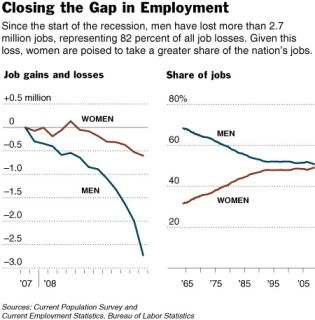
Of the 5.7 million jobs Americans lost between December 2007 and May 2009, nearly 80 percent had been held by men. [...] Men are bearing the brunt of the current economic crisis because they predominate in manufacturing and construction, the hardest-hit sectors, which have lost more than 3 million jobs since December 2007. Women, by contrast, are a majority in recession-resistant fields such as education and health care, which gained 588,000 jobs during the same period. Rescuing hundreds of thousands of unemployed crane operators, welders, production line managers, and machine setters was never going to be easy.
When put in a graphic this looks like this.


A devastating loss, not only for men, but also for the families, wives and children, those men are supporting. To counter this, there was the American Recovery and Reinvestment Act of 2009 investing $787 billion.
The president-elect's original plan was designed to stop the hemorrhaging in construction and manufacturing while investing in physical infrastructure that is indispensable for long-term economic growth. It was not a grab bag of gender-correct programs, nor was it a macho plan--the whole idea of economic stimulus is to use government spending to put idle factors of production back to work.
This sounds like a good idea right? The feminists of NOW disagreed.
The National Organization for Women (NOW), the Feminist Majority, the Institute for Women's Policy Research, and the National Women's Law Center soon joined the battle against the supposedly sexist bailout of men's jobs. At the suggestion of a staffer to Speaker of the House Nancy Pelosi, NOW president Kim Gandy canvassed for a female equivalent of the "testosterone-laden 'shovel-ready' " terminology. ("Apron-ready" was broached but rejected.) Christina Romer, the highly regarded economist President Obama chose to chair his Council of Economic Advisers, would later say of her entrance on the political stage, "The very first email I got . . . was from a women's group saying 'We don't want this stimulus package to just create jobs for burly men.' "

No matter that those burly men were the ones who had lost most of the jobs.
[...]
The senior economists listened attentively as Gandy and Smeal and other advocates argued for a stimulus package that would add jobs for nurses, social workers, teachers, and librarians in our crumbling "human infrastructure" (they had found their testosterone-free slogan). Did Furman mention that jobs in the "human infrastructure"--health, education, and government--had increased by more than half a million since December 2007?

"The Job Impact of the American Recovery and Reinvestment Plan" on January 10. They estimated that "the total number of created jobs likely to go to women is roughly 42 percent." Lest anyone miss the point, they added that since women had held only 20 percent of the jobs lost in the recession, the stimulus package now "skews job creation somewhat towards women."

[...]

In her March "Below the Belt" column on the NOW website, Kim Gandy could not contain her elation over "this happily-ever-after 'stimulus story.' " When she and her allies saw the final recovery package, they were amazed to find "over and over" versions of "very specific proposals that we had made." More than that, the programs NOW had proposed had vast sums of money next to them--"numbers that started with a 'B' (as in billion)," Gandy said gleefully. "It's impossible to convey just how many hours we put into this issue during December and early January and how fruitful it really turned out to be."

Right again. It is now four months since the bill was signed into law. A recent Associated Press story reports: "Stimulus Funds Go to Social Programs Over 'Shovel-ready' Projects." A team of six AP reporters who have been tracking the funds find that the $300 billion sent to the states is being used mainly for health care, education, unemployment benefits, food stamps, and other social services. According to Chris Whately, director of the Council of State Governments, "We all talked about 'shovel-ready' since September and assumed it was a whole lot of paving and building when, in fact, that's not the case." At the same time, the Labor Department's latest (June 5) employment report shows unemployment rates of 8 percent for women and 10.5 percent for men. "Unprecedented" is what Harvard economist Greg Mankiw called the new 2.5 percentage-point gender gap. "It's the highest male-female jobless rate gap in the history of BLS [Labor Department] data back to 1948," said Mark Perry.

[...]
Within living memory, the American feminist movement was a valiant, broad-based vehicle for social equality. It achieved historic victories and enjoys continuing, richly deserved prestige for its valor and success. But it has now harnessed that prestige to the ethos and methods of a conventional interest group. - from here
The whole article is worth reading, not only the words I borrowed. Another conclusion.
The stimulus plan, in it's feminist incarnation, channels about 42% of its funds towards women's jobs and 58% towards men's.  Given that only about 20% of jobs have been lost by women, that means women are getting over twice the benefit men are getting.

[...]

The feminist stimulus plan promotes jobs in sectors in which there's been little-to-no job loss while under-stimulating jobs in sectors where there's been plenty.
Does this sound like an equal approach? And again mainstream feminism didn't argue against such a policy.

EDIT: We have information on the effect of the stimulus money
The best symbol of the $787 billion federal stimulus program turns out not to be a construction worker in a hard hat, but rather a classroom teacher saved from a layoff.

On Friday, the Obama administration released the most detailed information yet on the jobs created by the stimulus. Of the 640,239 jobs recipients claimed to have created or saved so far, officials said, more than half — 325,000 — were in education. Most were teachers’ jobs that states said were saved when stimulus money averted a need for layoffs.

Although the stimulus was initially sold in large part as a public works program, only about 80,000 of the jobs that were claimed Friday were in construction.

But it gets worse.


Domestic Violence

And here is one for the "feminism is about fighting all stereotypes" crowd. Domestic violence is a highly politicized topic. According to feminist theory there is just patriarchal violence. Men batter their wives to control them. Patriarchial tyranny to keep women down. This all cumulates into the Duluth Model.
According to the Duluth Model, "women and children, and some men are vulnerable to violence because of their unequal social, economic, and political status in society."

The Duluth Model is based on a strict "patriarchal violence" model and presumes that all violence in the home and elsewhere has a male perpetrator and female victim. The model explicitly rejects any concept of mutuality or symmetry in abusive relationships. The Duluth Model originated the Duluth Power and Control Wheel. - from Wiki
And don't get me started about VAWA. However there is a lot of evidence showing us that a huge chunk of DV victims are men.
This bibliography examines 256 scholarly investigations: 201 empirical studies and 55 reviews and/or analyses, which demonstrate that women are as physically aggressive, or more aggressive, than men in their relationships with their spouses or male partners.  The aggregate sample size in the reviewed studies exceeds 253,500.  - from the Fiebert list of course
Now one of the most cited feminist source about DV is the National Violence Against Women Survey (NVWS). This study actually found, of all DV victims in that year 40% are men. Seing this number we can conclude that the view that DV is mostly men beating women is indeed a stereotype, but apparently not a stereotype worth fighting against.

If you look at the statistics NOW is citing you will find the NVWS and frankly no word about battered men. It could have been worse as the National Coalation against Domestic Violence (NCADV) show us on their fact sheet. They cite the NVWS (remember 40% of male victims) yet use a different study which much less male victims to minimize male victims, and that is the only use they had for this study. They cherry picked data to show us a twisted view of reality (why the crime study they cited had less male victims is something I talked about in the DV section alot, especially in my response to Barry Deutsch).

Again one might say that NOW does not represent most feminists so I was arguing on feministing the largest feminist blog there is (where else should I go? Do all the other feminists who really fight against all stereotypes hide in caves or something?). Cherry-picking the worst of the worst from that thread.
It is mainly done to women you dumb fuck!!! A quarter of U.S. women are killed, abducted, and raped by men! A quarter of men aren't killed, abducted, and raped by women!
I reported that post, but apparently to get a reaction, the post must be a personal attack AND against what the author of the site is thinking. Overall what I learned from the reaction on feministing is that feminists do not seem to care much about male victims. Or are not willing to fight that stereotype.

That stereotyping hurt is something feminist should be very aware of as they are fighting stereotyping of women/girls every day and night. This time stereotyping also leads to victims not comming forward and that includes not only men, but victims of lesbian DV as well.

The Silence of the feminists

More importantly it is not only what feminism is doing it is also what feminism is not doing or not talking about.

For example:
- The high male suicide rate coupled with the fact that depression is far less likely to be detected in men (infact more men kill themselves than the numbers of killed women, women killing themselves and women dieing in car accidents combined)
- More men living on the street / addicted to drugs
- Men leading in the top 10 reasons of death -> lower male life expectacy
- Prostate cancer that gets far less funding than breast cancer although the mortality rate is similar
- Testicular cancer prevention (most common cancer in the 20 year old age group)
- Men receiving harsher punishment for the same crime than women
- Boys falling way behind girls in schools (reading apprehension, school drop outs, ritalin drugging etc.)
- Male DV and Rape victims / female rapist and batterers
- Father's rights
- Workplace deaths
- Unequal support by the gouvernment (Vawa, Womens health etc.)
- False allegations
- The draft / conscription (in some countries)
- Negative media portrayal of men (70% negative)
- etc.
These are all topics feminists do not loose too much sleep about. Prove me wrong and show me a mainstream feminist blog/organisation etc. that dedicates a huge chunk of their efforts on men's issues (and no Ifeminists do not count as they get bashed all the time for being anti-feminist. Feminists can't attack them on a regular basis and then hide behind their backs).

Feminism101

Now what do feminists themselves say? I searched the feminism101 blog for answers. The goal of this blog is to provide answers on the topic of feminism and while the quesiton on the definition of feminism was shaky at best (we again learn that everyone who wants equality is a feminist, yep that would include me again, hooraay!) we can read between the lines of other questions. For example, "can men be feminists" included that one.
there are also men and women who are ideologically uncomfortable with men calling themselves feminists, because it seems to be a co-option of movements built by and for women. These groups express a preference for the terms pro-feminist or feminist allies when speaking of men who support and advocate feminism. - from here
We learn 2-things. One, men, be careful with the label feminist because some other feminist wouldn't see you as a "first class feminist" and two, and more importantly we learn that feminism is a movement "built by and for women".

Now we come to talking about mens problems on feminist spaces.
No one is saying that discussions on men and masculinities shouldn’t go on. It is absolutely important to have dialogue on men’s issues, including discussions on violence done towards men. The thing is, a feminist space — unless the topic is specifically men’s issues — is not the place to have that discussion and neither are spaces (feminist or otherwise) in which the topic is specifically focused on women’s issues. - from here
Again we learn two things. One, feminism is specially focused on women's issues and two, a feminist space is not the place to have a discussion about men's issues (unless the topic is specifically men's issues which happens how often? Check feministing (the biggest feminist blog) for men's issues and you will know how often).

We also learn that there is no sexism against men just benevolent sexism (against women), that men as a class have an institutional power over women and that there is no female privilege.

Of course one can argue that the group who has most voting power, controls most wealth, has better health, education and longlivety is the oppressed group while the group with the worse working condition, more homeless people, more people that commit suicides, is more often victimized, is disadvataged in courts, expected to die in wars and expected to give up their lives for the other groups when disaster strikes is the privileged one, but this post certainly isn't the right place to discuss this.

What's my name?

The most obvious at last. Feminism implies that this is a women's movement. Heck it is even called the women's movement. Looking at the workbook definition the Oxford English Dictionary tells us (according to feminism101, I don't own such a dictionary) the following:
FEMINISM: the advocacy of women's rights on the grounds of sexual equality
Nothing more to add.

Conclusion

The believe that supporting feminism and empowering women will magically make all problems men have disappear somehow is not new. You know what, that is what Gloria Steinem was promising in 1970 and quite honestly not much has happened.

But we know now via
- the name feminism
- the textbook definition of feminism
- the actions of feminists
- what feminist say about feminism
- what topics feminists are avoiding
that feminsim is not about ending all inequalities and that feminism is not about fighting all stereotypes. Yes, this is something many people (feminists including) already know.

To put it this way equalism or humanism is a coin with more than a feminism side. Is there something wrong with fighting for a special interest group? No, it isn't. Heck this is what the MRM is doing -> "the advocacy of men's rights on the grounds of sexual equality". It is however wrong to act as the great equalizer and ignore half of the population. Or as the Animal Farm quote goes.
"All animals are equal, but some animals are more equal than others"
So please stop pretending feminism is the only solution for every group there is, especially when you offer no solution for men's issues.

Thursday, September 3, 2009

Changes

This time a purely administrative post.

I beefed up the ressources list on the right side and included some of the finest links about Domestic Violence there are:
DVStats.org is a nice search Engine based on t he Fielbert list, that links to many studies.
Two links by Mediaradar.org. The 50 Myths cover almost everything. In addition the Fact sheet is a nice short overview. Mediaradar itself is a very well designed site and has much more ressources but those are the ones, I think are the most useful.
 And of course the fielbert list that recently crossed *drumroll pleased* the 200 Studies mark. Whew....a lot of resources.
This bibliography examines 256 scholarly investigations: 201 empirical studies and 55 reviews and/or analyses, which demonstrate that women are as physically aggressive, or more aggressive, than men in their relationships with their spouses or male partners.  The aggregate sample size in the reviewed studies exceeds 253,500. 
 It keeps growing and growing and growing.

Secondly as you probably noticed (if you visit my blog and not just read about it on antimisandry, you lazy git) I drasticly changed the Layout of this blog. The main reason for doing so was the squeezed text & pictures in the previous setting. With more space my uber-long posts are far easier to read. I am not sure if I keep the colour though, doesn´t look bad, but eventually I´ll go back to black. It would be perfect if the column on the right was on the left, but well one can´t have everything (if someone is willing to help, I am willing to listen).

What are your thoughts on the new layout? Better? Worse? Also I am looking for a new title...the equality from a mans perspective is just to generic.If someone comes up with a good idea, kudos to you.

Thats it...Feck out....

EDIT: Yowser turned the sides upside dow... I mean leftside right. Looks better now.

The strangest oppression in human history...

I´ll start with that one
Patriarchy is a system mainly oppressing women. And if women is the oppressed group there’s only one group left doing the oppressing: men.
For some strange reason when I hear of oppression, I must think about the apartheid in South Africa, the Jews under Nazi Germany and the racial segregation in the USA, but not women in the western world.

Just imagine, an oppression where...
...the oppressed actually have more voting power than the opressors
...special laws, funds and ministries are favoring the oppressed with no equivalent for the oppresserors
...the oppressed control more than half of all wealth
...violence against the oppressed by the oppressors is punished more harshly than the other way round
...the oppressors receive longer prison sentences for the same crime
...the oppressed are less likely to be victims of violent crime than the oppressors
...the oppressed are better educated
...the oppressed have the better health and live longer than the oppressors and far more ressources and fundings
...the oppressors are far more likely to be killed or to kill themselves than the other way round
...the oppressed have by far the better working conditions

And finally giving the fact that the huge majority of the oppressors as well as the oppressed, prefer a partner of the other group, is the final reason why that oppression failed horribly...even more so realising that the oppressed have the upper hand when it comes to voting power, health, education, control of wealth and the law, one is more likely to think of a privilleged group.

If you have something to add, let me know...