Tuesday, September 8, 2009

Feminism is NOT about ending ALL inequalities....

...especially when it comes to men's issues.

This might be something regular readers of this blog already know, however as this turns up in a debate with feminists annoyingly often, this will be the answer I'll be giving. A link to this post. Feel free to do this as well if you like.

For beginners in discussions between feminists and MRAs something like:
- Feminism is about ending all inequalities
- Feminists are fighting all stereotypes
regularly pops up. Sometimes with the slight undertone that a Men's Right Movement is not needed as all MRAs could just join feminism as if "equality between the sexes" (which by far most MRAs want as well) is an equivalent to feminism. It is not. I am starting with some examples.

Father's rights

One thing which feminists should be interested in is, without a doubt, father's rights. If women want an equal workforce, equal pay etc. it makes sense to push for father's rights because when dad takes care of the children mommy can work. The following is something father's rights activist Glenn Sacks wrote
“In my view, the feminists did a lot of good things during the sixties and seventies, and since then, they’ve done some good things, and I think they still occasionally do good things, but I think that they’ve also jumped the rails, and a lot of the stuff they do, particularly in family law and domestic violence, a lot of the stuff they do is very destructive and unfair,” he says.

“I think that in a lot of ways it’s a betrayal, because in the seventies, the feminist thing was: women are going to have their careers, and men are going to spend more time at home, and men are going to have more time with the children, and men will have the time to be more involved fathers because they’ll no longer have the burden of supporting the family themselves.

"And now, whenever there’s any kind of legislative attempt to try to make it so that fathers can have more time with their children after divorce, or fathers can have joint custody after divorce of fathers could have shared parenting after divorce –the feminists, all the time, right down the line, they fight it like crazy! And, to me, that’s just a total betrayal.” - from here
Two recent examples also from Glenn's blog
The Feminist Family Law Movement claims that abusive fathers often employ Parental Alienation as a way to wrest custody from protective mothers in family court. They push for reforms which will make it easier to deny fathers shared custody or visitation rights based on unsubstantiated abuse claims. They also push for laws to exclude evidence of Parental Alienation in family law proceedings.

The FFLM has promoted several cause celebre cases in recent years as a way to garner public sympathy and political support for their agenda. - from here
The same is happening in Canada with
[t]he National Association of Women and the Law (NAWL) is a feminist non-profit organization that has worked to promote the equality rights of all women in Canada since 1974. - from here

A take on an article by the NAWL can be read here. This part fits well into this post.
the whole point of the paper is to oppose a legislative initiative that would encourage and allow fathers to take up more of the childcare burden, thus freeing mothers to work and earn more.

Rationally, if feminists really wanted equality and to better women's lives, they'd support the presumption of equally shared parenting. Equalizing childcare will tend to equalize earnings, savings, employment, promotions, etc. Astonishingly, feminists don't want that.
And, *surprise surprise* the same is happening in Australia, too. Of course, one can argue that only radical feminists or a minority of the feminist movement fight against father's rights, but then again mainstream feminism is very silent when it comes to condemn such actions or father's rights in general. I don't doubt that one could find single feminists that support shared parenting if one is willing to look hard enough, but apparently that does not fall under the inequalities feminism is willing to fight.

NOW

The National Organization of Women, the biggest feminist group in the world, and arguably the political arm of feminism has a lot of political power. A recent example. Consider this.
Of the 5.7 million jobs Americans lost between December 2007 and May 2009, nearly 80 percent had been held by men. [...] Men are bearing the brunt of the current economic crisis because they predominate in manufacturing and construction, the hardest-hit sectors, which have lost more than 3 million jobs since December 2007. Women, by contrast, are a majority in recession-resistant fields such as education and health care, which gained 588,000 jobs during the same period. Rescuing hundreds of thousands of unemployed crane operators, welders, production line managers, and machine setters was never going to be easy.
When put in a graphic this looks like this.
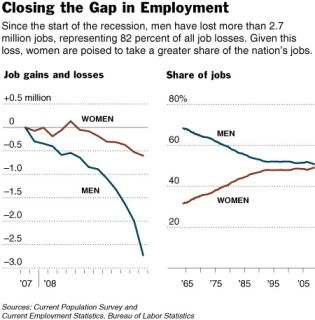


A devastating loss, not only for men, but also for the families, wives and children, those men are supporting. To counter this, there was the American Recovery and Reinvestment Act of 2009 investing $787 billion.
The president-elect's original plan was designed to stop the hemorrhaging in construction and manufacturing while investing in physical infrastructure that is indispensable for long-term economic growth. It was not a grab bag of gender-correct programs, nor was it a macho plan--the whole idea of economic stimulus is to use government spending to put idle factors of production back to work.
This sounds like a good idea right? The feminists of NOW disagreed.
The National Organization for Women (NOW), the Feminist Majority, the Institute for Women's Policy Research, and the National Women's Law Center soon joined the battle against the supposedly sexist bailout of men's jobs. At the suggestion of a staffer to Speaker of the House Nancy Pelosi, NOW president Kim Gandy canvassed for a female equivalent of the "testosterone-laden 'shovel-ready' " terminology. ("Apron-ready" was broached but rejected.) Christina Romer, the highly regarded economist President Obama chose to chair his Council of Economic Advisers, would later say of her entrance on the political stage, "The very first email I got . . . was from a women's group saying 'We don't want this stimulus package to just create jobs for burly men.' "

No matter that those burly men were the ones who had lost most of the jobs.
[...]
The senior economists listened attentively as Gandy and Smeal and other advocates argued for a stimulus package that would add jobs for nurses, social workers, teachers, and librarians in our crumbling "human infrastructure" (they had found their testosterone-free slogan). Did Furman mention that jobs in the "human infrastructure"--health, education, and government--had increased by more than half a million since December 2007?

"The Job Impact of the American Recovery and Reinvestment Plan" on January 10. They estimated that "the total number of created jobs likely to go to women is roughly 42 percent." Lest anyone miss the point, they added that since women had held only 20 percent of the jobs lost in the recession, the stimulus package now "skews job creation somewhat towards women."

[...]

In her March "Below the Belt" column on the NOW website, Kim Gandy could not contain her elation over "this happily-ever-after 'stimulus story.' " When she and her allies saw the final recovery package, they were amazed to find "over and over" versions of "very specific proposals that we had made." More than that, the programs NOW had proposed had vast sums of money next to them--"numbers that started with a 'B' (as in billion)," Gandy said gleefully. "It's impossible to convey just how many hours we put into this issue during December and early January and how fruitful it really turned out to be."

Right again. It is now four months since the bill was signed into law. A recent Associated Press story reports: "Stimulus Funds Go to Social Programs Over 'Shovel-ready' Projects." A team of six AP reporters who have been tracking the funds find that the $300 billion sent to the states is being used mainly for health care, education, unemployment benefits, food stamps, and other social services. According to Chris Whately, director of the Council of State Governments, "We all talked about 'shovel-ready' since September and assumed it was a whole lot of paving and building when, in fact, that's not the case." At the same time, the Labor Department's latest (June 5) employment report shows unemployment rates of 8 percent for women and 10.5 percent for men. "Unprecedented" is what Harvard economist Greg Mankiw called the new 2.5 percentage-point gender gap. "It's the highest male-female jobless rate gap in the history of BLS [Labor Department] data back to 1948," said Mark Perry.

[...]
Within living memory, the American feminist movement was a valiant, broad-based vehicle for social equality. It achieved historic victories and enjoys continuing, richly deserved prestige for its valor and success. But it has now harnessed that prestige to the ethos and methods of a conventional interest group. - from here
The whole article is worth reading, not only the words I borrowed. Another conclusion.
The stimulus plan, in it's feminist incarnation, channels about 42% of its funds towards women's jobs and 58% towards men's.  Given that only about 20% of jobs have been lost by women, that means women are getting over twice the benefit men are getting.

[...]

The feminist stimulus plan promotes jobs in sectors in which there's been little-to-no job loss while under-stimulating jobs in sectors where there's been plenty.
Does this sound like an equal approach? And again mainstream feminism didn't argue against such a policy.

EDIT: We have information on the effect of the stimulus money
The best symbol of the $787 billion federal stimulus program turns out not to be a construction worker in a hard hat, but rather a classroom teacher saved from a layoff.

On Friday, the Obama administration released the most detailed information yet on the jobs created by the stimulus. Of the 640,239 jobs recipients claimed to have created or saved so far, officials said, more than half — 325,000 — were in education. Most were teachers’ jobs that states said were saved when stimulus money averted a need for layoffs.

Although the stimulus was initially sold in large part as a public works program, only about 80,000 of the jobs that were claimed Friday were in construction.

But it gets worse.


Domestic Violence

And here is one for the "feminism is about fighting all stereotypes" crowd. Domestic violence is a highly politicized topic. According to feminist theory there is just patriarchal violence. Men batter their wives to control them. Patriarchial tyranny to keep women down. This all cumulates into the Duluth Model.
According to the Duluth Model, "women and children, and some men are vulnerable to violence because of their unequal social, economic, and political status in society."

The Duluth Model is based on a strict "patriarchal violence" model and presumes that all violence in the home and elsewhere has a male perpetrator and female victim. The model explicitly rejects any concept of mutuality or symmetry in abusive relationships. The Duluth Model originated the Duluth Power and Control Wheel. - from Wiki
And don't get me started about VAWA. However there is a lot of evidence showing us that a huge chunk of DV victims are men.
This bibliography examines 256 scholarly investigations: 201 empirical studies and 55 reviews and/or analyses, which demonstrate that women are as physically aggressive, or more aggressive, than men in their relationships with their spouses or male partners.  The aggregate sample size in the reviewed studies exceeds 253,500.  - from the Fiebert list of course
Now one of the most cited feminist source about DV is the National Violence Against Women Survey (NVWS). This study actually found, of all DV victims in that year 40% are men. Seing this number we can conclude that the view that DV is mostly men beating women is indeed a stereotype, but apparently not a stereotype worth fighting against.

If you look at the statistics NOW is citing you will find the NVWS and frankly no word about battered men. It could have been worse as the National Coalation against Domestic Violence (NCADV) show us on their fact sheet. They cite the NVWS (remember 40% of male victims) yet use a different study which much less male victims to minimize male victims, and that is the only use they had for this study. They cherry picked data to show us a twisted view of reality (why the crime study they cited had less male victims is something I talked about in the DV section alot, especially in my response to Barry Deutsch).

Again one might say that NOW does not represent most feminists so I was arguing on feministing the largest feminist blog there is (where else should I go? Do all the other feminists who really fight against all stereotypes hide in caves or something?). Cherry-picking the worst of the worst from that thread.
It is mainly done to women you dumb fuck!!! A quarter of U.S. women are killed, abducted, and raped by men! A quarter of men aren't killed, abducted, and raped by women!
I reported that post, but apparently to get a reaction, the post must be a personal attack AND against what the author of the site is thinking. Overall what I learned from the reaction on feministing is that feminists do not seem to care much about male victims. Or are not willing to fight that stereotype.

That stereotyping hurt is something feminist should be very aware of as they are fighting stereotyping of women/girls every day and night. This time stereotyping also leads to victims not comming forward and that includes not only men, but victims of lesbian DV as well.

The Silence of the feminists

More importantly it is not only what feminism is doing it is also what feminism is not doing or not talking about.

For example:
- The high male suicide rate coupled with the fact that depression is far less likely to be detected in men (infact more men kill themselves than the numbers of killed women, women killing themselves and women dieing in car accidents combined)
- More men living on the street / addicted to drugs
- Men leading in the top 10 reasons of death -> lower male life expectacy
- Prostate cancer that gets far less funding than breast cancer although the mortality rate is similar
- Testicular cancer prevention (most common cancer in the 20 year old age group)
- Men receiving harsher punishment for the same crime than women
- Boys falling way behind girls in schools (reading apprehension, school drop outs, ritalin drugging etc.)
- Male DV and Rape victims / female rapist and batterers
- Father's rights
- Workplace deaths
- Unequal support by the gouvernment (Vawa, Womens health etc.)
- False allegations
- The draft / conscription (in some countries)
- Negative media portrayal of men (70% negative)
- etc.
These are all topics feminists do not loose too much sleep about. Prove me wrong and show me a mainstream feminist blog/organisation etc. that dedicates a huge chunk of their efforts on men's issues (and no Ifeminists do not count as they get bashed all the time for being anti-feminist. Feminists can't attack them on a regular basis and then hide behind their backs).

Feminism101

Now what do feminists themselves say? I searched the feminism101 blog for answers. The goal of this blog is to provide answers on the topic of feminism and while the quesiton on the definition of feminism was shaky at best (we again learn that everyone who wants equality is a feminist, yep that would include me again, hooraay!) we can read between the lines of other questions. For example, "can men be feminists" included that one.
there are also men and women who are ideologically uncomfortable with men calling themselves feminists, because it seems to be a co-option of movements built by and for women. These groups express a preference for the terms pro-feminist or feminist allies when speaking of men who support and advocate feminism. - from here
We learn 2-things. One, men, be careful with the label feminist because some other feminist wouldn't see you as a "first class feminist" and two, and more importantly we learn that feminism is a movement "built by and for women".

Now we come to talking about mens problems on feminist spaces.
No one is saying that discussions on men and masculinities shouldn’t go on. It is absolutely important to have dialogue on men’s issues, including discussions on violence done towards men. The thing is, a feminist space — unless the topic is specifically men’s issues — is not the place to have that discussion and neither are spaces (feminist or otherwise) in which the topic is specifically focused on women’s issues. - from here
Again we learn two things. One, feminism is specially focused on women's issues and two, a feminist space is not the place to have a discussion about men's issues (unless the topic is specifically men's issues which happens how often? Check feministing (the biggest feminist blog) for men's issues and you will know how often).

We also learn that there is no sexism against men just benevolent sexism (against women), that men as a class have an institutional power over women and that there is no female privilege.

Of course one can argue that the group who has most voting power, controls most wealth, has better health, education and longlivety is the oppressed group while the group with the worse working condition, more homeless people, more people that commit suicides, is more often victimized, is disadvataged in courts, expected to die in wars and expected to give up their lives for the other groups when disaster strikes is the privileged one, but this post certainly isn't the right place to discuss this.

What's my name?

The most obvious at last. Feminism implies that this is a women's movement. Heck it is even called the women's movement. Looking at the workbook definition the Oxford English Dictionary tells us (according to feminism101, I don't own such a dictionary) the following:
FEMINISM: the advocacy of women's rights on the grounds of sexual equality
Nothing more to add.

Conclusion

The believe that supporting feminism and empowering women will magically make all problems men have disappear somehow is not new. You know what, that is what Gloria Steinem was promising in 1970 and quite honestly not much has happened.

But we know now via
- the name feminism
- the textbook definition of feminism
- the actions of feminists
- what feminist say about feminism
- what topics feminists are avoiding
that feminsim is not about ending all inequalities and that feminism is not about fighting all stereotypes. Yes, this is something many people (feminists including) already know.

To put it this way equalism or humanism is a coin with more than a feminism side. Is there something wrong with fighting for a special interest group? No, it isn't. Heck this is what the MRM is doing -> "the advocacy of men's rights on the grounds of sexual equality". It is however wrong to act as the great equalizer and ignore half of the population. Or as the Animal Farm quote goes.
"All animals are equal, but some animals are more equal than others"
So please stop pretending feminism is the only solution for every group there is, especially when you offer no solution for men's issues.

Thursday, September 3, 2009

Changes

This time a purely administrative post.

I beefed up the ressources list on the right side and included some of the finest links about Domestic Violence there are:
DVStats.org is a nice search Engine based on t he Fielbert list, that links to many studies.
Two links by Mediaradar.org. The 50 Myths cover almost everything. In addition the Fact sheet is a nice short overview. Mediaradar itself is a very well designed site and has much more ressources but those are the ones, I think are the most useful.
 And of course the fielbert list that recently crossed *drumroll pleased* the 200 Studies mark. Whew....a lot of resources.
This bibliography examines 256 scholarly investigations: 201 empirical studies and 55 reviews and/or analyses, which demonstrate that women are as physically aggressive, or more aggressive, than men in their relationships with their spouses or male partners.  The aggregate sample size in the reviewed studies exceeds 253,500. 
 It keeps growing and growing and growing.

Secondly as you probably noticed (if you visit my blog and not just read about it on antimisandry, you lazy git) I drasticly changed the Layout of this blog. The main reason for doing so was the squeezed text & pictures in the previous setting. With more space my uber-long posts are far easier to read. I am not sure if I keep the colour though, doesn´t look bad, but eventually I´ll go back to black. It would be perfect if the column on the right was on the left, but well one can´t have everything (if someone is willing to help, I am willing to listen).

What are your thoughts on the new layout? Better? Worse? Also I am looking for a new title...the equality from a mans perspective is just to generic.If someone comes up with a good idea, kudos to you.

Thats it...Feck out....

EDIT: Yowser turned the sides upside dow... I mean leftside right. Looks better now.

The strangest oppression in human history...

I´ll start with that one
Patriarchy is a system mainly oppressing women. And if women is the oppressed group there’s only one group left doing the oppressing: men.
For some strange reason when I hear of oppression, I must think about the apartheid in South Africa, the Jews under Nazi Germany and the racial segregation in the USA, but not women in the western world.

Just imagine, an oppression where...
...the oppressed actually have more voting power than the opressors
...special laws, funds and ministries are favoring the oppressed with no equivalent for the oppresserors
...the oppressed control more than half of all wealth
...violence against the oppressed by the oppressors is punished more harshly than the other way round
...the oppressors receive longer prison sentences for the same crime
...the oppressed are less likely to be victims of violent crime than the oppressors
...the oppressed are better educated
...the oppressed have the better health and live longer than the oppressors and far more ressources and fundings
...the oppressors are far more likely to be killed or to kill themselves than the other way round
...the oppressed have by far the better working conditions

And finally giving the fact that the huge majority of the oppressors as well as the oppressed, prefer a partner of the other group, is the final reason why that oppression failed horribly...even more so realising that the oppressed have the upper hand when it comes to voting power, health, education, control of wealth and the law, one is more likely to think of a privilleged group.

If you have something to add, let me know...

Facts about the "Purse Power" of women

Yeah it is spending by women and that aspect of the wage gap again. It sounds a bit ridiculous if you complain that one group is discriminated when it comes to wages, yet almost every dollar runs through that groups hands.
Facts about the "Purse Power" of women:

Women are the dominant spending force in almost every retail/business category and are the most affluent and influential consumers of today.

  • Of all consumer purchases, women are responsible for 83%
  • Homes: Directly purchase or influence the purchase of 91% of all new homes
  • Home fix-up purchases: More than 55%
  • Retail: Account for 88% of customers in the US & Canada
  • Auto: Make more than 50% of all auto purchases and influence 85%.
  • Home furnishings: 94%
  • Vacation choices: 92%
  • House purchases: 91%
  • Consumer electronics purchases: 51% (women are involved in 89% of all consumer electronic purchase decisions)
  • Home Computers: Account for 66% of all purchases
  • Bank Accounts: Hold 89% of all accounts
  • Credit Cards: Women carry 76 million credit cards, 8 million more then men—(Fast Company, 2004)
  • Healthcare: Make 80% of Healthcare decisions and account for 67% of spending
  • Health: Purchase 65% of herbal remedies, vitamins and minerals and purchase 80% of all healthcare
  • Beauty and hygiene: Purchase more than 90%
  • Clothes, accessories: Wear more than 90% of items such as jewelry and perfume
  • Meetings: Plan the meetings and comprise the majority of certified meeting planners
  • Office Supplies: Purchase $44.5 billion
  • Lawn movers: Purchase approximately 81% of riding lawn mowers
All facts noted above are from the 2005 Wow! Quick Facts book and the U.S. Census Bureau, 2004 - from here
And more and more....
American women spend about $5 trillion annually…Over half the U.S. GDP

Consulting firm A.T. Kearney estimates that women determine 80% of consumption, purchase 60% of all cars and own 40% of all stocks 
70% of new businesses are started by women

Women represent the majority of the online market - from here
and more and more....
Tons of facts and figures related to female marketing were presented the Marketing to women conference in Chicago.

Here’s a small selection:
- In the US, women control $7 trillion in consumer and business spending (from The power of the purse
- 30,7% of women outearn their husbands (Bureau of Labor Statistics and the US census)
- women owned businesses now employ more people in the US than the Fortune 500 companies combined
- women purchase 90% of beauty products, 94% of apparel, 89% of home products, 81% of gifts and 51% of consumer electronics
- in the US, women earn more bachelors degrees than men
- from here
and more and more (yeah I am being creative here, well what do you expect it is just a collection of numbers)...

  • Women dominate the marketplace as consumers of goods and services, including housing, electronics, automobiles, travel and healthcare. Women make over 85% of consumer purchases and influence 95% of all purchases of goods and services.
  • Women-owned and controlled businesses constitute a growing segment of the economy. Women own over 46% of privately held companies in the U.S. In 2004, women-owned businesses employed more than 19 million people and generated $2.46 trillion in sales.
  • Women control substantial assets and investments. Women constitute 47% of all investors. They comprise 41% of those reporting incomes of $500,000 or more, and they control $14 trillion of assets. In addition to handling 75% of all household finances, women make more than 53% of all investment decisions.
  • Women will make up nearly half of the U.S. labor force. Women constitute 52% of the adult U.S. population. In 2005, women comprised 46.4% of all full-time wage and salaried workers. In 2003, they earned nearly 60% of all bachelor's and master's degrees and more than 47% of all doctorates. 
- from here
Remember we are talking about an oppressed group here...
Women’s roles in society, the economy, and at home have evolved to where an increasing amount of decision-making and control falls to women. Unlike women in previous generations, today’s woman finds herself in an unprecedented societal and economic shift:
  • The percentage of women in the workforce almost doubled in the second half of the last century, from 32% to 62%.
  • Today there are one-third more women graduating from college than men.
  • Women’s median income has increased over 60% over the past thirty years, while men’s median income has hardly increased at all.
  • The number of women earning $100,000+ has quadrupled in last decade.
  • Sixty percent of women with business degrees out-earn their husbands.
  • Women account for half of all stock market investors.
  • It is expected that by 2010, women will control 60% of wealth in the United States. 
- from the new Allianz Women, Money, and Power Study.  2006
And finally
  1. Women accounted for 51 percent of all workers in the high-paying management, professional, and related occupations. They outnumbered men in such occupations as public relations managers; financial managers; human resource managers (Feck: Glass ceiling? Who is hiring? Women I guess); education administrators; medical and health services managers; accountants and auditors; budget analysts; biological scientists; preschool, kindergarten, elementary, middle, and secondary school teachers; physical therapists; writers and authors; and registered nurses.
  2. Of persons aged 25 years and older, 29 percent of women and 30 percent of men had attained a bachelor’s degree or higher; 31 percent of women and men had completed only high school, no college. 
- from here
That was a bit. Probably the group with the most spending power on this planet is american women.
 ---------------------------------
EDIT: Found something more, but too less for another spending post.
Statistics overwhelm and convince us that women are the market and the economy
as demonstrated not only by the Business Women’s Network but Marty Barletta in her new book on marketing to women.

[...]

Services are the same story…

* New bank accounts (89%)
* Healthcare (80% of decisions, over two-thirds of all health care spending)

When you add the purchasing officers who are women, it is an American Woman’s Economy that accounts for over half of the U.S. GDP…about $55 trillion.” Translation: Earth’s largest economy…American Women. (Barletta, M., 2003) - from here
And the last one...
Senior women age 50 and older control net worth of $19 trillion and own more than three-fourths of the nation’s financial wealth. – MassMutual Financial Group–2007

Of the 743 women of wealth interviewed with at least $3 million in investable assets, 61.2% accumulated their fortunes through corporate employment, their own or a family business or a professional practice. Only 38.8% of the women had married into or inherited their money. – Women of Wealth, 2004, by Russ Alan Prince and Hannah Shaw Grove

High-net-worth women account for 39% of the country’s top wealth earners; 2.5 million of them have combined assets of $4.2 trillion. More than 1.3 million women professionals and executives earn in excess of $100,000 annually. 43% of Americans with more than $500,000 in assets are female – MassMutual Financial Group–2007

Over the next decade, women will control two thirds of consumer wealth in the United States and be the beneficiaries of the largest transference of wealth in our country’s history. Estimates range from $12 to $40 trillion. Many Boomer women will experience a double inheritance windfall, from both parents and husband. The Boomer woman is a consumer that luxury brands want to resonate with. – Claire Behar, Senior Partner and Director, New Business Development, Fleishman-Hillard New York

Once the college bills are out of the way and children launch their own households, the discretionary spending power of 50-plus women soars. They spend 2.5 times what the average person spends. Women are the primary buyers for computers, cars, banking, financial services and a lot of other big-ticket categories. – Marti Barletta, Primetime Women

The number of wealthy women investors in the U.S. is growing at a faster rate than that of men. In a two-year period, the number of wealthy women in the U.S. grew 68%, while the number of men grew only 36%. – The Spectrem Group - from here
Okay one more to go...you should read that one because of the rest, too
Each year, on balance, men hand trillions of dollars they’ve earned over to women to spend. Some of these vast transfers are through the tax system, and some through inheritance by widows. (She-conomy.com claims, for whatever it’s worth, “Senior women age 50 and older control net worth of $19 trillion and own more than three-fourths of the nation’s financial wealth.”) Nonetheless, most male-to-female handovers are from husbands who are specialists at making money in a particular career to their more generalist wives, who take on for the family the bulk of the onerous task of trying to spend it wisely.

Still, women tend not only to be more interested shoppers, but also more enthusiastic shoppers. For example, a 1995 survey found that women are more likely than men to admit that they shop to celebrate, buy without need, buy unplanned items, and can’t resist a sale. - from here

Fathers rights...

A mesh up of two posts found by Glenn Sacks. First of all this overview by Robert Franklin
The list of all the obstacles placed between fathers and children by courts and legislatures would fill a book, but here are a few:
  • Laws that give only married fathers presumptive rights.
  • No requirement that fathers be informed of a pregnancy or birth of their children. 
  • No requirement that the father's name be placed on the birth certificate.
  • No legal consequences for paternity fraud.  
  • Putative father registries that permit adoptions without notice to the father. 
  • Failure to punish perjury in adoption proceedings.  
  • Fraudulently-obtained default judgments.(? I didn´t get that one)  
  • Failure to enforce visitation orders on behalf of non-custodial fathers.  
  • Failure to grant primary custody to fathers in more than 16% of cases. 
  • Setting child support levels without regard to the father's ability to pay (See, Office of Child Support Enforcement report.)  
  • Failure to provide summary procedures to reduce child support to reflect reduced earnings. 
  • Issuance of child support orders against men who aren't the father of the child to be supported.  
  • Wholesale issuance of restraining orders without supporting evidence.  
  • Allowing perjury in family court to go unpunished.  
  • Allowing custodial parents to move away and thwart visitation.  
  • Debtor's prison for fathers who don't have the ability to pay support obligations. 
  • Refusal of state CPS workers to contact fathers before placing children in foster care.  
  • Active promotion of divorce by women's DV shelters.  
  • Absence of DV shelters for fathers and their children.
Another piece found on Glenn Sacks, written by Dutch child and educational psychologist Peter Tromp, is so full of good stuff, I just can´t ignore. We start with Shared parenting.
Better outcomes for children in shared parenting arrangements

From a meta-analysis on 33 underlying separation researches Robert Bauserman (American Psychological Association, 2002) concluded, that children growing up in a form of shared parenting with frequent contact with and care from both parents, had
- less behavioural – and emotional problems,
- exhibited higher levels of self-worth and self-confidence,
- were better capable of building and preserving social contacts and relations, both within and outside the family and
- performed better at school,
than children who had grown up in the sole care of only one of their parents.

Children growing up in shared parenting of both parents after divorce and separation did so much better than children growing up under sole care of only one of their parents, that shared parenting arrangements after separation by far proved to be the “second best” parenting arrangement for growing up children, providing them with a new post-divorce family situation that best approached the ideal situation of an intact family.

From a range of other researches it further became clear, that children growing up in shared parenting of both parents
- develop better,
- are more satisfied,
- prove to be better adapted and adjusted and
- have more self-confidence and self-worth
in comparison with children growing up in sole care of one of their parents (Nunan, 1980; Cowan, 1982; Pojman, 1982; Livingston, 1983; Noonan, 1984; Shiller, 1984.,1986; Handley, 1985; Wolchik, 1985; Bredefeld, 1985; Öberg & Öberg, 1987).

From a Harvard study on 517 separation families over a period of 4 years wide, children growing up under post-divorce shared parenting proved to be less depressed, exhibited less unadjusted behaviours, and achieved better school results than children growing up in post-divorce sole care. (Buchanan, MacCoby, Dornbusch, 1996.)

Also, boys growing up in shared parenting are found to have less emotional problems than boys growing up in sole care (Pojman 1982; Shiller 1986).

[...]

Post-divorce father involvement in children’s lives makes all the difference

Another line of comparative research focuses on the different effects on children of growing up with either involved or not involved (i.e. excluded) non-residential fathers after parental separation and divorce.

Carlson (2006) found in her research “Family structure, father involvement and behavioural effects on adolescents” based on the 1996 and 2000 data cohorts of the USA National Longitudinal Youth Study on 2.733 10-14 year old adolescents living only with their mothers while their fathers were non-residential that the greater the involvement of fathers was in the lives of their adolescent children, the less behavioural problems the adolescents had in terms of aggression, antisocial behaviour, and negative feelings like anxiety, concern, depression and low self-esteem.

[...]

The meta-study conducted by Robert Bauserman (APA, 2002) however found that, in contrast with what is usually claimed, the number and levels of conflicts between the parents in shared parenting arrangements strongly diminished in comparison with the number of conflicts in situations of sole care with access arrangements. As a result these lower level of conflicts between the divorced parents in shared parenting arrangements contributes greatly to better child welfare and well being.

Moreover, not only do parents experience less mutual conflicts in shared parenting arrangements, but also children growing up in shared parenting appear to have fewer conflicts with their parents, than children growing up in sole care of one parent (Karp, 1982).

[...]

It is also frequently claimed by antagonists to shared parenting that children growing up in shared parenting arrangements with both parents do not have a place and home of their own (“Do not take away the children’s home”, it is claimed). Children in shared parenting arrangements are pictured as being constantly underway between houses and as being continuously exposed to conflicts of allegiance. Available research however confounds this picture. Children are more flexible – within reason of course – than we expect them to be. What is more important to them is keeping their relations with both their parents. (Steinman, 1981, Luepnitz, 1986, Shiller, 1986, Coller, 1988, Tornstam, 2000).

[...]

From child-research in which children themselves are questioned on their preferences however, it becomes clear that children themselves also most prefer shared parenting and care from both their parents after separation (Fabricius, 2003). Children themselves most want to preserve and maintain their relations with both parents after divorce and separation. They consider having narrow links and bonds with both their parents as being important to them, while growing up in shared parenting leaves them more satisfied than growing up in sole care. (Kelly, 1993).

[...]

Finally, children of divorce growing up in single parent mother-headed families themselves are at a 3,5 times greater risk of separation and divorce later on in their lives (Spruijt, 2007), thus contributing to a self perpetuating and accelerating cycle of new broken families into the future.

Post-divorce shared parenting arrangements on the other hand however – instead of accelerating the pace of separation and divorce resulting into broken families in the future – also prove to be a valuable incentive for keeping two-parent families together when possible. The more shared parenting arrangements are to be implemented instead of mother-only custody and care after separation, the fewer parents are inclined to go for a divorce. (Brinig & Allen, 2000) This contributes directly to the best interest of the children involved, as all of the research so far has indicated that intact two-parent families are still the best and most ideal setting for children to grow up in and flourish into the jewel in society’s crown they deserve to be, instead of growing to be a liability and burden on the state.

[...]

This situation of 30% of children left fatherless or with marginalized fathers after parental separation is prevalent in most European Union countries, including the new East European members. The incidence of fatherlessness tends to be still somewhat lower in Southern European countries and higher in Northern European countries.

For future trends we need to look at the USA, being at the forefront of the situation where Europe is also heading to. And in the USA now already 40% of all children are growing up completely fatherless (Source: Newsweek figures from January 2006).

A recent Dutch research study on the Parental Alienation Syndrome in the Netherlands (Kaplan, 2008) found PAS in the Netherlands to be a much bigger problem than was previously estimated. Some of the main conclusions of the Dutch study on Parental Alienation are:
• 72% of Dutch separated fathers believe PAS to be a problem.
• 64% of mothers believe PAS to be a problem
• According to father’s PAS is a severe problem in 21% of cases
• But according to mothers PAS is only a severe problem in 10% of cases.
• Overall Dutch fathers consider serious PAS twice as big a problem as Dutch mothers
A little reminder shared parenting is something some feminist groups are actively fighting in Canada and the USA. But there will be another post. We continue with the effects that missing fathers have on kids.
Adverse effects on children’s health and well-being of growing up fatherless in one-parent families

The available research clearly shows that children growing up in sole care – mainly fatherless and with their mothers in mother-headed families – do much worse than children growing up in shared parenting.

Children being raised by one parent are at a greater risk for many things as they grow up, including health risks such as poorly controlled diabetes and asthma. (Holmes, 2007)

A Swedish large scale population study on children’s health found that children growing up fatherless in single-parent families also have more depression complaints, use more and earlier drugs and alcohol (binge-drinking), get more accidents and more often commit suicide, than children growing up in the care and with the involvement of both parents. (Swedish population study into the consequences of single-parent families on children, Ringbäck Weitoft, Hjern, Haglund, Rosén, 2003).

And a recent Dutch study on the importance of fathers for their children after parental separation and divorce (ENOVA, 2008) found that in the Dutch province of Drenthe 62% of all children in need of special youth care and youth welfare provided by the Dutch state originated from single parent families headed by mothers.

Also a consistency has now been determined between growing up in fatherless single-parent families and the prevalence of children being diagnosed with attention deficit and hyperactivity disorder ADHD/ADD. Children in single parent families are at twice the risk of being ADHD-diagnosed and prescribed with the drug Ritalin than children from intact two-parent families (Strohschein, 2007).

Child abuse risk and “new boyfriend-” or stepparent-risk

Child abuse can happen in all types of families, but it happens most in single parent mother-headed families and in new “patchwork-families” with stepchildren.

Children, especially boys, growing up in single parent mother-headed families are at twice to 2,5 times the risk of child sexual abuse, physical abuse, emotional and mental abuse and neglect by either the mother herself or her “new friend”, the so-called “stepparent”. (Holmes, 2007; AMK, 1999, 2000, 2001)

[...]

Effects on children of growing up fatherless in single parent families in the different age groups (O’Neill, 2002)

Children (0-12)

If we take a closer look at the effects of growing up fatherless on the different age groups children (0-12) growing up in fatherless single-parent families have a greater risk of a life in poverty, run more risk on physical, emotional and sexual abuse, more often become runaways from home, have a greater risk of becoming homeless youths, have more risk of health complaints and have more problems at school and in their social contacts with others (O’Neill, 2002).

Teenagers (12-18)

Teenagers growing up in fatherless single-parent families have a greater risk of teenage-pregnancy, to end up in (youth) crime, to smoke, to use alcohol and drugs, of playing truant, to be suspended, of becoming drop-outs and ending their school careers at an early age school, and of getting adaptation problems (O’Neill, 2002).

Young adults (18 onwards)

And young adults, having grown up in fatherless single-parent families, stand a greater risk of not having finished a proper vocational education, earning lower incomes, becoming jobless and in need of benefits, at risk of becoming homeless, or of getting involved in crime, of developing chronic emotional and mental-health problems, of developing general physical health complaints, and sooner have cohabiting relations, more often have extramarital children, only to end up in separation and divorce more often. (Meta-study “Experimenting in living, The fatherless family”, Civitas, O’Neill, 2002).

Parentification of children of divorce in single parent families

British teenage-girls who have grown up in sole care or single parent families reported that they get stressed out and overloaded by the separation problems of their parents, especially caused by the call on them by their caring parent, in 90% of the cases the mother, for support in the fight concerning the children, put up with the other parent after divorce and separation. (Bliss survey, 2005: Girls take strain or parents’ split)

In single parent families it is often not the child who is being taken care of by the parent, but – as “mother’s little helper” – the child becomes an instrumental friend and partner to the parent in distress taking care of the parent’s welfare instead, thus forcing children of divorce into early maturation and depriving them of their youth. This phenomenon is documented in the psychological literature as that of “parentification”.
Whew....I concentrated on the data here and let out the analysis of European countries and law reform, to not completely rip the original of. I suggest your read it though. It is a very well done document.

Wednesday, September 2, 2009

Mothers Gap

The factoid, or better a collection of a similar factoids, that explains the wage gap in one sentence. I spoiled it in the titel, but the wage gap is in reality more of a mothers gap. As usual I´ll let others do the talking.
The Pay Gap: 'If It's About Discrimination, Why Are Young Urban Women Earning More?'
The New York Times front page headline recently tells us that "For Young Earners in Big City, Gap Shifts in Women's Favor." The big surprise? New York City women between 21 and 30 working full-time made 117% of men's wages. Everyone is wondering why. Here's why, for starters...
When I did the research for Why Men Earn More in 2005, I discovered that nationwide never-married women who had never had children earned 117% of the wages of never married men who had never had children. Manhattan women in their twenties are less likely to have married or had children than women in their twenties who live in suburban and rural areas. The overall pay gap with men earning more is not about discrimination; it is mostly about the division of labor once children arrive.
The usual men-earn-more pay gap is also about trade-offs. The road to high pay is a toll road. On average, men are more willing to pay the tolls of the more hazardous jobs (accounting for 94% of workplace deaths), to work on commissions, relocate overseas, travel overnight and travel weekends (approximately 90% of the most frequent flyers are men), work late nights and night shifts, work weekends, intensify their work commitment during child-raising years, work in engineering, computer sciences, technology and the hard sciences where the supply doesn't match the demand, and do all of the twenty-five most important trade-offs that on average lead to men earning more.
The good news is that any woman can learn to out earn men should she be willing to make more of the twenty-five trade-offs than the average man makes. - from here
But it is not only Farell.
A more accurate picture comes from a 2007 report prepared for the U.S. Department of Labor by the CONSAD Research Corp.

Although women do not lead as many Fortune 500 companies (only 3 percent, according to Obama), they account for 51 percent of all workers in the high-paying management, professional and related occupations, according to the study. Women outnumber men, for example, as financial managers, human resource managers, education administrators, medical and health services managers, and accountants and auditors.

Otherwise, wage differences can be explained by "observable differences in the attributes of men and women," including, among many, the fact that a greater percentage of women than men take leave for childbirth and child care, which tends to lead to lower wages. Also, women may place more value on "family-friendly" workplace policies and prefer non-wage compensation, such as health insurance or flexibility.

The statistical analysis, which included these and other variables, produced an adjusted gender wage gap between 4.8 percent and 7.1 percent. The gap shrinks to almost nothing when men and women of equal backgrounds and tenure are compared, according to another study of young, childless men and women.

While no one would argue that women shouldn't be compensated as well as men for the same work, it isn't quite accurate to suggest a widespread problem of wage discrimination.

Or, as the Labor Department labor study warns against, to justify policy-level correctives.

Whatever imbalances remain should be self-correcting as women and men achieve educational parity, but that's if boys get some help. Indeed, men and women reached educational parity with college graduation rates in 1982. Today, women receive 58 percent of bachelor's degrees and represent half of graduates in medical and law school.

Boys, meanwhile, are the ones dropping out of school or being expelled. They're the ones failing, abusing drugs and committing suicide. What kind of men do we expect them to become, assuming they survive? - from here
And another one...
For example, in a 2005 NBER working paper "What Do Wage Differentials Tell Us about Labor Market Discrimination?" by June O'Neill (Professor of economics at Baruch College CUNY, and former Director of the Congressional Budget Office), she conducts an empirical investigation using Census data and concludes that:
"There is no gender gap in wages among men and women with similar family roles. Comparing the wage gap between women and men ages 35-43 who have never married and never had a child, we find a small observed gap in favor of women, which becomes insignificant after accounting for differences in skills and job and workplace characteristics.
This observation is an important one because it suggests that the factors underlying the gender gap in pay primarily reflect choices made by men and women given their different societal roles, rather than labor market discrimination against women due to their sex." - from here
And even back in the days there was no huge difference
In fact, most Americans would be shocked to learn that even in the 1950s, the pay gap between men and never-married women (i.e., those women who were unlikely to have temporarily left the work force in order to raise children) was less than 2 percent. Never-married white women actually earned 6 percent more than never-married white men a half-century ago. - from here
What is true for the USA seems to be true for the UK as well.
The mothers' pay gap

It's not being a woman but having children that creates pay inequality and should be compensated for – hang on, it already is

[...]

There is no gender pay gap in the UK, there is only a mothers' pay gap.

The basic figures that everyone is working from can be found here (pdf), from the Office of National Statistics. No one is disagreeing with the raw data, the only differences are over which figures we should cherry-pick, how we should combine the various pieces. You'll not be all that surprised to find that those such as Harman, who think that women are hard done by in our society, tend to pick numbers showing the gap to be rather higher than others do. I of course am cherry-picking with the best of them but this table is instructive, drawn from the same data.

As you can see, it is marriage and more especially the having of children that leads to what everyone refers to as the gender pay gap and what should therefore more properly be referred to as the mothers' pay gap. Now that we've correctly identified the reason for differential pay on average, we can decide what, if anything, we'd like to do about it. For if it is indeed motherhood that is causing the gap then all of the current recommendations in the equalities bill are really a little odd. Equal pay audits at companies aren't going to do much about the way that parturition affects income now, are they?

What might be much simpler is to just directly compensate women for the income they forgo by having children. After all, we're pretty sure (some nutters aside) that we want the species and the country to continue into the future, and since biology has made only one of the sexes able to ensure this (with minor assistance from the other needed, to be sure) then the rest of us should just suck up the cost for the public good.

What would that cost be? Rather than argue about median household, or median or mean individual income, just to keep things simple let's peg the average income that will be affected by having children at £20,000 a year. A nice round number (and we'll stick with rounding numbers). Thus we expect a woman who has one child to be forgoing about £2,500 a year or £50 a week. With three children it's £70 a week. So if we were to subsidise mothers by this much (and other appropriate sums for other numbers of children) then we would have abolished the mothers' pay gap. Something that at least some of us devoutly desire.

Where this becomes really interesting is that of course we do already subsidise mothers. The combination of child benefit and the child tax credit is, at least for those on that average income, rather more than the effect on earnings of that mothers' pay gap.

Which leads to, at least to me, a fascinating conclusion. We don't have a gender pay gap in the UK, we have a mothers' pay gap. That mothers' pay gap has already been sorted out by the direct subsidies that we give to women with children. Which leads on to an even more fascinating question.

Why are we faffing about in parliament with an equalities bill to deal with something we've already solved? - from here
And more from the UK.
Pay gap between men and women is not due to discrimination but to their lifestyle choice, says study

[...] Professor John Shackleton, of the University of East London, said that in reality the pay gap hardly existed for workers under 30.

He said men work longer hours in more dangerous jobs and face a greater risk of being sacked, while women who take career breaks outnumber their male equivalents by more than five to one.

In a paper for the Institute of Economic Affairs, he pointed out that single, widowed or divorced women earn more than their male counterparts, but the pay gap between men and women in families with three children was 19 per cent. - from here
And finally we get psychological.
Want equal pay?

The psychologist Susan Pinker asked, in a book titled The Sexual Paradox, and plainly designed to tease, “why females are biologically driven to nurture their young rather than climb the corporate ladder”. Why indeed? But it's a perfectly valid choice if some decide that the rat race isn't for them.

The really interesting comparison isn't between women and men but between single, childless women and men. If you compare women who aren't married or cohabiting with men who aren't married or cohabiting, you know what? The pay gap goes the other way. Hourly pay for the women is £8.82; for men £8.72. The moral is that if women want equal pay, they should give up men and children. Any takers? - from here
In conclusion this is all very simple and logical. In a team of two, the one who takes more care of the kids earns less than the one who simply works more. Women do this more often than men. One on one, women fare off a bit better, probably because of better education. So in short, wage gap = mothers gap.

Tuesday, September 1, 2009

Brazil: 17-year old girl kills 30 men....

Unbelieveable:
The schoolgirl stunned cops by owning up to a serial killing spree that started when she was a 15-year-old.
She told detectives she wanted to confess before she turned 18 and could be tried as an adult.
The girl - too young even to be named - said she began targeting men in her home city of Sao Paulo, Brazil "for money, revenge and to bring justice". 
She even SMILED as she reeled off her list of victims - which is feared to make her the world's most prolific teenage serial killer. She calmly bragged to police: "I don't have enough courage to hold a gun - but I can hold a knife.  
The schoolgirl told how she always used the same knife - butchering one man for throwing a glass of brandy in her face in a bar row. - from here