Men account for more than two-fifths (41%) of adult victims of human trafficking in England and Wales helped by the Salvation Army, contrary to the public perception that the crime almost exclusively affects women.
The finding comes in a survey by the charity, which provides specialist support for the adult victims of trafficking on behalf of the Ministry of Justice.[...] The charity's survey found that 45% of those it supported had been forced into sexual exploitation, 43% were involved in labour exploitation and 8% were trafficked into domestic servitude. [...] Minister for justice, Crispin Blunt, said: "Human trafficking is often seen as predominantly affecting women – meaning that male victims are often overlooked and are forced to go without the support they so desperately need."
Showing posts with label Trafficking. Show all posts
Showing posts with label Trafficking. Show all posts
Friday, April 27, 2012
Trafficking victims in the UK
I am not really surprised judging by previous surveys I have seen. Here is the article:


Monday, November 2, 2009
Trafficking: Blown out of proportion?
Another post about trafficking. And I am pretty sure simply by saying trafficking you know that I actually talk about the 4% of slaves that are forced into prostituion (instead of the 96% of labour slaves).
Anyhow, a recent move against trafficking in the UK really went the wrong way (found via Glenn Sack's blog).
Ouch...in a follow up post, we learn that the officials had a hard time to find any evidence for the thousands of trafficked women at all. Also another interesting comment.
Anyhow, a recent move against trafficking in the UK really went the wrong way (found via Glenn Sack's blog).
The Home Office estimates that there are between 6,000 and 18,000 trafficked women and girls being forced to work as prostitutes in the UK.
[...]
The UK's biggest ever investigation of sex trafficking failed to find a single person who had forced anybody into prostitution in spite of hundreds of raids on sex workers in a six-month campaign by government departments, specialist agencies and every police force in the country.
[...]
Current and former ministers have claimed that thousands of women have been imported into the UK and forced to work as sex slaves, but most of these statements were either based on distortions of quoted sources or fabrications without any source at all.
Ouch...in a follow up post, we learn that the officials had a hard time to find any evidence for the thousands of trafficked women at all. Also another interesting comment.
Nikki Adams, for her part, has some ideas about that. She and her organization have defended sex workers in court and attempted to help them in many ways for years. She says that in all that time of helping prostitutes in the United Kingdom, she has encountered a grand total of two who had been coerced into the trade. Her very strong opinion is that essentially all prostitutes engage in sex for hire as their free choice for the purposes of earning an income. That view, of course, accords with the findings (or non-findings) of Operation Parameter Two, the police sweep of houses of prostitution, that found no traffickers whatsoever.After reading this I was reminded of a similar case in Germany. Googling "trafficking world cup Germany" will get you many results. An example
It has been estimated that some 40,000 women, many under age, will have been be illegally trafficked into Germany for the World cup games. Germany, like most countries, has had a problem of illegal trafficking for some time but what is unusual is the scale of the trafficking and the fact that Germany is making so many plans to encourage it.One of many articles. No matter what you heard, the 40,000 under-age trafficked prostitutes where all over the net. Apparently just in the net.
In Berlin, close to the Olympic stadium, a new mega-brothel has just opened. Covering some 400 square meters, it houses a health club, restaurants, and some 70 rooms where up to 600 clients a day may be serviced. Similar brothels in Cologne and Dortmund will open before the games begin. Other cities have set up drive-thru centers, nicknamed “ Verrichtungsbox” roughly translated as “performance boxes” where sex will be performed in small cubicles to ensure the anonymity of the clients.
Last summer, lurid headlines claimed that 40,000 women would be smuggled by sex slavers into Germany to be prostituted to World Cup football fans. The truth is very different indeed. Newly unrestricted European Union documents reveal that the German police uncovered just five cases of ‘human trafficking for the purpose of sexual exploitation’ related to the international football tournament.It really makes you wonder where these high numbers come from. Probably not the most reliable sources.
Despite a huge ‘awareness-raising’ campaign, the setting up of telephone hotlines run by non-governmental organisations, and extra police checks on Germany’s borders, the prostitution scare stories, boosted by an unholy alliance of European left-wingers, feminists, police officers, Christians, the American right and US President George W Bush, have turned out to be pure fiction.
[...]
‘The increase in forced prostitution and human trafficking for the purpose of sexual exploitation during the 2006 World Cup in Germany which was feared by some did not materialise’, concludes one report. ‘There was no sign whatsoever of the alleged 40,000 prostitutes/forced prostitutes - a figure repeatedly reported, also in international media - who were to be brought to Germany for the 2006 World Cup.’
German police officers and border guards stepped up operations in the run-up to and during the World Cup, but the huge effort failed to find the pimps, or their victims, said to be swarming across Europe’s frontiers.
[...]
In contrast to the horror stories involving enslaved Africans, Latin Americans, Asians or Russians, the five were from countries that are members of the EU, or which were soon to be members, and all were entitled to travel freely to Germany; indeed, one was actually a German. Of the others, two were from Bulgaria, one from the Czech Republic, another Hungarian victim was a 20-year-old man.
[...]
‘Fifty-one cases of forced prostitution were discovered, 23 of those were suspicions, 28 cases proved to be cases of forced prostitution’, says the report. ‘However, all these cases, as all calls in general, were not connected to the FIFA World Cup, but to trafficking in general.’
Tuesday, June 30, 2009
Trafficking again....
Just a short one with another tidbit of information:
Forced Labor- A very official link -> http://www.state.gov/g/tip/rls/tiprpt/2009/123126.htm
The majority of human trafficking in the world takes the form of forced labor, according to the ILO’s estimate on forced labor. Also known as involuntary servitude, forced labor may result when unscrupulous employers take advantage of gaps in law enforcement to exploit vulnerable workers. These workers are made more vulnerable to forced labor practices because of high rates of unemployment, poverty, crime, discrimination, corruption, political conflict, and cultural acceptance of the practice. Immigrants are particularly vulnerable, but individuals are also forced into labor in their own countries.
Tuesday, June 23, 2009
The extend of sexual slavery....
My second post about trafficking. In my first post about this topic I blogged about forgotten male victims and that trafficking is merely seen as sex-trafficking, where victims are almost always women or girls. It is always interesting to hear contrary voices.
4%?!? Quite contrary to that:
Greatly underestimated...there seems to be a mixing of terms as well. As victims of sexual-trafficking doesn´t necessarily mean being exploited, but can also mean to choose working as a prostitude:
We can now assume that the huge number of 70% also include a lot of women who willingly enter prostitution. And it gets more bizarre, now women get rescued by anti-trafficking groups, against their will, an example from Thailand:
Unbelieveable. Those women above willingly earned 4.5 times the average and life has been made far worse by the rescue. One blogger hit the nail on the head:
It turns out the war against trafficking is nothing more than a crusade against prostitution, which leaves a bitter aftertaste in my mouth when thinking about forgotten labour slaves.
The profits generated worldwide by all forms of slavery in 2007 was 91.2 billion American dollars. That is second only to drug trafficking in terms of global, criminal, illicit enterprises. 40 percent of this money is produced by the 4 percent of slaves that work in the sex industry. [Kara, Siddharth (October 2008). Sex Trafficking - Inside the Business of Modern Slavery. Columbia University Press. ISBN 978-0231139601.]
4%?!? Quite contrary to that:
Due to the illegal nature of trafficking and differences in methodology, the exact extent is unknown. According to United States State Department data, an "estimated 600,000 to 820,000 men, women, and children [are] trafficked across international borders each year, approximately 70 percent are women and girls and up to 50 percent are minors. The data also illustrates that the majority of transnational victims are trafficked into commercial sexual exploitation." However, they go on to say that "the alarming enslavement of people for purposes of labor exploitation, often in their own countries, is a form of human trafficking that can be hard to track from afar." Thus the figures for persons trafficked for labor exploitation are likely to be greatly underestimated.From Wiki
Greatly underestimated...there seems to be a mixing of terms as well. As victims of sexual-trafficking doesn´t necessarily mean being exploited, but can also mean to choose working as a prostitude:
There is no universally accepted definition of trafficking for sexual exploitation. The term encompasses the organized movement of people, usually women, between countries and within countries for sex work with the use of physical coercion, deception and bondage through forced debt. However, the issue becomes contentious when the element of coercion is removed from the definition to incorporate facilitating the willing involvement in prostitution. For example, In the United Kingdom, The Sexual Offences Act, 2003 incorporated trafficking for sexual exploitation but did not require those committing the offence to use coercion, deception or force, so that it also includes any person who enters the UK to carry out sex work with consent as having being trafficked.From Wiki
Save the Children stated "The issue gets mired in controversy and confusion when prostitution itself is considered as a violation of the basic human rights of both adult women and minors, and equal to sexual exploitation per se..... trafficking and prostitution become conflated with each other.... On account of the historical conflation of trafficking and prostitution both legally and in popular understanding, an overwhelming degree of effort and interventions of anti-trafficking groups are concentrated on trafficking into prostitution"
[...]
In Japan the prosperous entertainment market had created huge demand for commercial sexual workers, and such demand is being met by trafficking women and children from the Philippines, Colombia and Thailand. Women are forced into street prostitution, based stripping and live sex acts. However, from information obtained from detainees or deportees from Japan, about 80 percent of the women went there with the intention of working as prostitutes
We can now assume that the huge number of 70% also include a lot of women who willingly enter prostitution. And it gets more bizarre, now women get rescued by anti-trafficking groups, against their will, an example from Thailand:
Over the past three years there has been an increased international and national focus on the situation of women who have been trafficked.From here
However, the focus on trafficking in persons has meant many groups with little or no experience on the issues of migration, labor, sex work or women's rights have been created to take advantage of the large sums of money available to support anti-trafficking activities. Their inexperience and lack of contact with the sex worker community has meant they are unable or unwilling to differentiate between women who have been trafficked and migrant workers. They also show a great deal of trouble differentiating between women and girls, often applying identical standards and solutions for both. It is obviously inappropriate to treat a girl as an adult and just as obviously inappropriate to treat an adult as a child.
[...]
Prior to the 2nd of May women from a brothel called Baan Rom Yen had been studying Thai daily with Empower, joining our outside activities e.g. attending a workshop on migrant's rights, going to swimming lessons, going to a local water fall. Women also had access to the public health weekly and were provided with safe sex equipment and skills by Empower. None of these women had talked about being trafficked and when they discussed their work, plans and dreams none showed any need or wish for outside rescue.
On the 1st of May three of the women collected their savings from the owner and contacted a van in order to take them home to Burma on Friday 2nd of May. One of these three went with a customer on the 1st of May and didn't come back. Her friends and employer were worried for her. The other women postponed their trip home in order to wait for her.
At 11 pm May 2nd women heard people yelling "police". Those that could get away did and the others were "caught". Everyone, including the brothel owner saw the missing woman in the police car, saw her name on the arrest warrant and assumed that she had gone to the police.
[...]
Journalists and photographers also accompanied the police and "rescue team". Photos of the women were taken without their consent and appeared in the local papers and TV the next day.
[...]
Women who were "rescued" understood they had been arrested. They had their belongings taken from them.
[...]
In all 28 women were "rescued". Some of the women were not employees of that brothel but were simply visiting friends when they were "rescued". Women were transported by Trafcord and the police against their will to a Public Welfare Boys Home. Nineteen women were locked inside and have remained there for the past 31 days. We have no information on the whereabouts or situation of the other ten women.
[...]
They are only permitted to use their phones for a short time each evening and must hide in the bathroom to take calls outside that time. They report that they have been subjected to continual interrogation and coercion by Trafcord. Women understand that if they continue to maintain that they want to remain in Thailand and return to work that they will be held in the Public Welfare Boys Home or similar institution until they recant. Similarly they understand that refusing to be witnesses against their "traffickers" will further delay their release.
[...]
They were shocked to hear that the raid had not been about arresting women but rather in order to 'rescue" those women who were victims of trafficking.
Each of the women were emphatic that all the workers were well informed before coming, had made satisfactory salary arrangements with the employer, had the freedom to leave and all were 19 years and over.
One woman who has a 50,000 baht advance from the owner had traveled home twice in the past two months to visit family etc. Although she had borrowed the money as an advance against her wages she felt no fear or threat. She and the others were all supported by the management to refuse customers, attend to health care, access safe working equipment, education and training. They were receiving an average of 600 Baht a day (the minimum wage in Chiang Mai Thailand is 133 Baht a day) They now find themselves unable to work.
[...]
They had fled the brothel leaving their possessions and savings behind. The brothel was now locked and they were unable to regain their goods.
[...]
These women have nowhere to stay, no money and therefore are unable to access basic needs including medical care and education.
[...]
All the women being held plan to return to work as soon as possible after their inevitable deportation. This will of course result in them paying yet another transport fee and facing more risks, including the risk of being "rescued" again.
Traffickers and many anti-trafficking groups employ very similar methods to achieve their goals. Both groups deceive women, transport them against their will, detain them, and put them in dangerous situations.
Unbelieveable. Those women above willingly earned 4.5 times the average and life has been made far worse by the rescue. One blogger hit the nail on the head:
It’s the season when the United States issues its annual Trafficking in Persons Report (TIP). Having named sexual slavery as a particular evil to be eradicated, the United States grades other countries on how they are doing.From here
On the one hand, it sounds like an obvious way to do good: Describe the ghastly conditions you as a rich outsider observe in poor countries. Focus on places where sex is sold. Say all women found were kidnapped virgins and are now enslaved; announce to the world that you will liberate them. Organize raids. Denounce anyone who objects - even if their objection is that you are intervening in their country’s internal affairs. Ignore victims who resist rescue. Use lurid language and talk continuously about the most sensational and terrible cases. Justify your actions as a manifestation of faith, as though it exists only for you. Mutter about “organized crime.”
[..]
For crusading politicians and religious leaders, a rhetoric of moral indignation is effective in uniting constituents and diverting the collective gaze away from familiar problems at home. So the culprits, those who get bad grades in the TIP, live far away from U.S. culture, which is assumed to be better. Intransigent local troubles - prisons overflowing with African Americans, millions of children malnourished - are swept aside in the call to clean up other people’s countries.
This moral indignation emanates from people who live comfortably, who are not wondering where their next meal will come from or how to pay doctors’ bills. These moral entrepreneurs do not have to choose between being a live-in maid, with no privacy or free time and unable to save money because the pay is so bad, and selling sex, which pays so well that you have time to spend with your children or read a book, money to buy education or a phone.
It is easy to haul out sensationalistic language (sex slavery, child prostitution), but it is much harder to sort out the real victims from the more routinely disadvantaged and trying-to-get-ahead. Those who know intimately the problems of the poor in their own cultures rarely deny that they can decide to leave home and pay others to help them travel and find work, in sex or in any other trade.
“But sex for money is disgusting and degrading; no one should have to do it.” And should anyone have to clean toilets all day? Risk being maimed in unsafe fireworks factories? Should children have to spend their lives in lightless tunnels of mines, or women have to remain married to men who are cruel to them? The world is full of things we wish we could eradicate - but isn’t starvation the first of them? Why is there no equivalent moral furor over hideous poverty? Are we meant to believe that sex without love is worse than military violence? All over the world, selling sex pays better than most jobs readily available to women, and many do not believe it is the worst possible experience they can have.
What’s questionable about the TIP is not the defense of children or anyone else against true violence - it’s one government’s assumption that it has the right to judge everyone else and apply a draconian definition of exploitation that does not ask people whether and how they would like to change their lives. Questionable is the focus on the photogenic, cowboy moment of rushing in to rescue slaves, with no interest in what will follow.
[...]
From the standpoint of social science, the TIP is gravely faulty. It never explains how data were gathered and compared across so many languages and cultures, or who did it exactly under what circumstances. A raft of other research shows enormous diversity among people who sell sex, and a wide variety of experiences in the sex industry among both migrants and people who stay at home. Studies show that the worst kind of trafficking can happen to people doing other kinds of jobs - and to men. Women all over the world, including the poorest, repudiate being characterized as above all sexually vulnerable.
It turns out the war against trafficking is nothing more than a crusade against prostitution, which leaves a bitter aftertaste in my mouth when thinking about forgotten labour slaves.
Thursday, February 26, 2009
Bad women: Trafficking
This is the first post with the label "Bad Women". This is not about demonizing women, but to counter the common stereotypte that women are good, while men are bad. This stereotype is often the reason that when you read news articles about female genital mutilation it is often not mentioned that this is a crime done to women by women and of course men that get "circumcised" under the same conditions than women achieve no attention, but I am extravagating now. When we talk about trafficking the exact same things happen.
I recently posted an article on AM I am dublicating right now:
A new report by the UNO about human trafficking. And well surprise, surprise among the criminals we find a huge amount of women:
Global Report on Trafficking in Persons
The Report is here
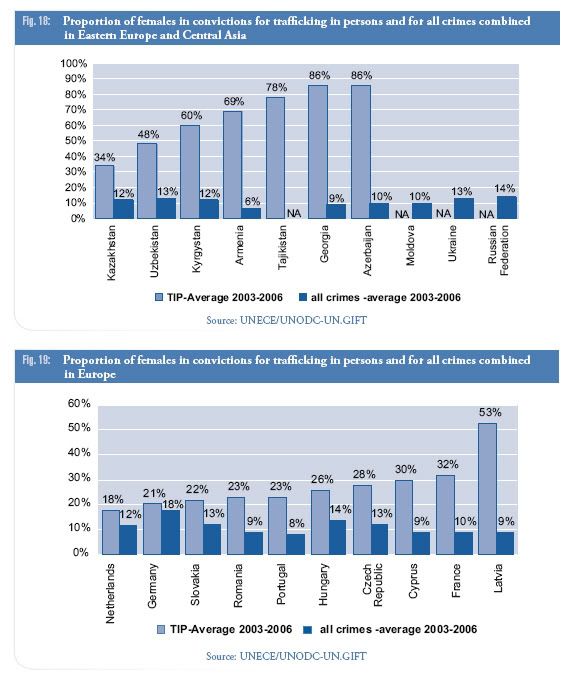
Now we see a huge chunk of the perpetrators seem to be women (leading criminals in 30% of the countries). People could come to the conclusion that 70% of the criminals are indeed men. I suspected sth differen, quoting me again:

I recently posted an article on AM I am dublicating right now:
A new report by the UNO about human trafficking. And well surprise, surprise among the criminals we find a huge amount of women:
| UNODC Report on Human Trafficking Exposes Modern Form of Slavery A Global Report on Trafficking in Persons launched today by the United Nations Office on Drugs and Crime (UNODC) provides new information on a crime that shames us all. Based on data gathered from 155 countries, it offers the first global assessment of the scope of human trafficking and what is being done to fight it. It includes: an overview of trafficking patterns; legal steps taken in response; and country-specific information on reported cases of trafficking in persons, victims, and prosecutions. At the launch of the Report in New York, the Executive Director of UNODC, Antonio Maria Costa said that "many governments are still in denial. There is even neglect when it comes to either reporting on, or prosecuting cases of human trafficking". He pointed to the fact that while the number of convictions for human trafficking is increasing, two out of every five countries covered by the UNODC Report had not recorded a single conviction. According to the Report, the most common form of human trafficking (79%) is sexual exploitation. The victims of sexual exploitation are predominantly women and girls. Surprisingly, in 30% of the countries which provided information on the gender of traffickers, women make up the largest proportion of traffickers. In some parts of the world, women trafficking women is the norm. The second most common form of human trafficking is forced labour (18%), although this may be a misrepresentation because forced labour is less frequently detected and reported than trafficking for sexual exploitation. |
The Report is here
Now we see a huge chunk of the perpetrators seem to be women (leading criminals in 30% of the countries). People could come to the conclusion that 70% of the criminals are indeed men. I suspected sth differen, quoting me again:
For example, do you believe there is more human trafficking in Germany (21% women) or in Georgia (86% women)?Very smart Feck....Now there is proof for that:
I suspect if you count the numbers of all people Trafficking and do a gendered statistic there will be more than 30% women.
Isn´t this incredible? Women trafficking women. There is more on this topic and let me recite the bits I already posted:Most traffickers are women - UN 25/02/2009 14:20 - (SA)
Pretoria - Up to 75% of all perpetrators of human trafficking are women, according to a study released in Pretoria on Wednesday.
Apart from being offenders themselves, over 70% of women were victims of trafficking, noted the Global Report on Trafficking in Persons, by the UN Office of Drugs and Crime (UNODC).
The study was conducted in 155 countries, between 2007 and 2008.
"Between 65% and 75% of offenders are women," said UNODC regional representative Jonathan Lucas.
More women convicted for trafficking
In countries that participated in the study, 30% more women than men were convicted for trafficking.
"Women play an important role, more than men and boys," said Lucas.
[...]Main form of exploitation
Sexual exploitation was found to be the main form of exploitation in southern Africa and the rest of the world. This was closely followed by forced labour, said Kruger. - from here
The second most common form of human trafficking is forced labour (18%), although this may be a misrepresentation because forced labour is less frequently detected and reported than trafficking for sexual exploitationThis is another point that often is forgotten when we talk about trafficking. Male victims are often overseen although a lot of men are forced to work as slaves or to be child soldiers.
Sexual exploitation was found to be the main form of exploitation in southern Africa and the rest of the world. This was closely followed by forced labour
Other sources show us that there is indeed a lot of forced work:
The fight against human trafficking has for more than a decade tried to protect women and children, often forgetting that men, too, are victims of "new slavery".
Thailand remains one of the region's busiest human-trafficking centres.
The National Human Rights Commission has looked into the stories of some of these forgotten victims - male migrant workers not recognised as casualties of the trade.
The commission reports that between July 17 and July 19 of 2003, six fishing trawlers with about 100 crew sailed from Tha Chalom in Samut Sakhon province to fish Indonesian territorial waters. Most of the crew were migrant workers and four were younger than 16. None were allowed home leave for three years. The trawlers returned to Thailand in July last year.
Thirty-eight never returned, dying on the job. Two were buried on one of Indonesia's myriad islands and the rest unceremoniously dumped at sea. One more crewmember died shortly upon his return.
Others returned home seriously ill - emaciated, emotionally disturbed and unable to see, hear or walk properly.
A Samut Sakhon Hospital medical report diagnosed the men with serious vitamin deficiencies. They had suffered months without proper food or water, eating only fish.
None have been paid. Yet, they are not considered by law to be victims of human trafficking.
When they demanded compensation their "employers" claimed the men were unknown and said crew employment was the responsibility of trawler skippers. The boat owners refuse to pay until the men can prove they were aboard.
Complicating the issue is the registration of the men under Thai names. They are all Burmese, Mon and Karen migrant workers.
They discovered the labour law in this country does not cover fishermen working outside Thai territory for more than a year.
But, a new memorandum of understanding on Common Guidelines for Concerned Agencies Engaged in Human Trafficking and the Prevention and Suppression of Human Trafficking Bill are rays of hope. Men are covered by both documents.
The memorandum was signed last week and broadens the scope of a similar 2003 document. That included "children and women" only in its target groups.
Concerned agencies in 17 northern provinces signed it and it has now expanded to cover men.
The memorandum will bring Thailand and its Social Development and Human Security Ministry up to world standards of protection.
Thailand is regarded as a "country of origin, transit and destination" for trafficking victims.
The government announced in 2004 that combating the trade was a priority. It provided national mechanisms, Bt500 million in funding and operational centres to fight trafficking.
But, as its name suggests, the 1997 Prevention and Suppression of Women and Children Trafficking Act does not help men.
Trafficking goes beyond the sex industry and child labour and many cases involve men, Sub-Committee on Coordination for Combating Trafficking in Children and Women chairperson Saisuree Chutikul said.
[...]
Raman was forced to work as a brick-maker to pay off a debt incurred years before by his grandfather. For years, he was paid three rupees (two cents) for a bag of bricks. If he didn't work hard enough and long enough, he was beaten with a stick.
Michael, 15, was kidnapped to serve as a combatant in the Ugandan Lord's Resistance Army. During that that time, he was forced to kill another boy, and on another occasion was forced to watch as a boy was hacked to death.
Over the last 10 years, globalization has triggered an unprecedented demand for unskilled and low-skilled laborers. Employers from countries with booming economies in Europe, Asia, and the Near East scour the globe in search of willing bodies to work in construction, manufacturing, agriculture, and domestic work.
Because working conditions are often grim, employers often tap the most vulnerable segments of the population. In some cases, women and girls are caught up in prostitution rings.
In its worst form, a desperate parent sells a child into modern-day slavery. Like young Nayla of Azerbeijan, ransomed by her mother to traffickers, who was then shipped to Dubai to work as a club prostitute. No one knows the extent to which human trafficking exists around the world, but many believe able-bodied males represent the most vulnerable group. A recent United Nations report, Trafficking in Persons: Global Patterns, noted, "it is men especially who might be expected to be trafficked for forced labor purposes."
A report issued last month by the U.S. State Department notes that in several parts of the world, boys are forced into pick-pocketing gangs. In West African countries, men posing as Moslem scholars lure young boys away from their parents with the promise of teaching them the Koran. Once removed from the custody of their parents, the boys are turned into common street beggers. In the Middle East, 2,000 young boys from Bangladesh have been taken away from their families to become camel jockeys in the Persian Gulf states. These boys are highly sought-after because they are the lightest possible riders for races. And when civil conflicts flare up in Africa and Latin America, boys as young as 12 years old find themselves pressed into military combat.
There are those who would have us believe that the misfortunes of women are somehow more compelling, and therefore they are more deserving of human rights protections.
That became apparent in 2000 when the United Nations passed its Protocol to Prevent, Suppress, and Punish Trafficking in Persons, Especially Women and Children. What about men?
That bias is also found in the legislation of many countries. According to the Trafficking in Persons report, "In many countries, the laws relevant to human trafficking are restricted in their application solely to women. . . In addition, many service providers limit their support and protection only to female and child victims. Thus, exploitation through forced labor is often quite unlikely to come to the attention of those dealing with victims."
Once human trafficking is defined as a crime that only affects women, statistics become meaningless. U.S. authorities have stated that up to two million women and children are trafficked each year across international borders.
But a 2002 report from the Washington, DC-based Migration Policy Institute exposed the flaw behind that claim: These "numbers are widely regarded as very conservative because they do not including trafficking within countries, nor do they take into account the trafficking of men." Gender bias persists to this day.
Recently Janice Shaw Crouse wrote an article for National Review titled "No Tolerance for Human Trafficking." Despite its high-minded invocation of the human rights issue, Crouse's article does not devote a single word to the male victims of human trafficking.
Crouse's crusade is to curb prostitution, a human vice that is demeaning to women and men alike. But in the process, she tries to smear the entire military establishment: "It's a given that prostitution coexists with military bases and installations. Where there are military forces, you'll find brothels."
Mrs. Crouse makes no mention of the laborers with calloused hands and broken hearts whose passports are removed by their employers and told to work ever harder. No comment about the men who are ordered to never report the abuses being perpetrated against them. Nothing of the millions of Ramans and Michaels around the world who are forced into lives of destitution and involuntary servitude.
It is high irony that some segments of a movement that purports to advance human rights would deem half the world's population as less worthy of attention and concern. That stance, morally repugnant and intellectually indefensible, undermines the very notion of human rights for all. - from here
A new report, from organisation for migration research IOM, exposing that within traffickingThis is a pattern that is common. Male victims as well as female perpetrator are overseen and violence or crimes against women are apparently more important than crimes against men. So much for equality...
75 % is about slavery work in other areas than the sex industry.
[...]
EASTERN EUROPE – Research Shows Significant Figures on Human Trafficking
16.02.2007
An IOM research carried out partly to devise estimates on the numbers of trafficked people in five Eastern European countries claims that an estimated 225,000 people have fallen victims to the crime.
The IOM research, carried out in Belarus, Bulgaria, Moldova, Romania and Ukraine through surveys among the general public in cooperation with the GfK, a leading research group for Eastern Europe, is an attempt to tackle one of the most difficult issues around human trafficking – how to gauge the extent of the crime. Figures on human trafficking within Europe are widely cited as an estimated 200,000 out of a global estimate of at least one million people.
However, the mean estimate of just over 225,000 people in these five countries alone was reached after asking respondents questions that included whether they knew anyone in their immediate family who had ever been trafficked for various forms of exploitation using a methodology validated by the University of Nebraska in the USA.
Ukraine, the country with the largest population out of the five, had the largest number of estimated victims – about 117,000 people. It, along with Moldova and Belarus also had the highest rates of trafficking prevalence. Estimated trafficking figures for the remaining countries are: Moldova (57,000), Romania (28,000), Belarus (14,000) and Bulgaria (9,500).
[...]
The report highlighted the need for stronger protection of labour migration as research showed high levels of trafficking for labour exploitation in sectors such as agriculture, construction and domestic servitude, rather than for sexual exploitation. This would be especially needed in Bulgaria and Belarus where the growth potential for labour migration were the highest of any of the five countries. - from here
Subscribe to:
Posts (Atom)